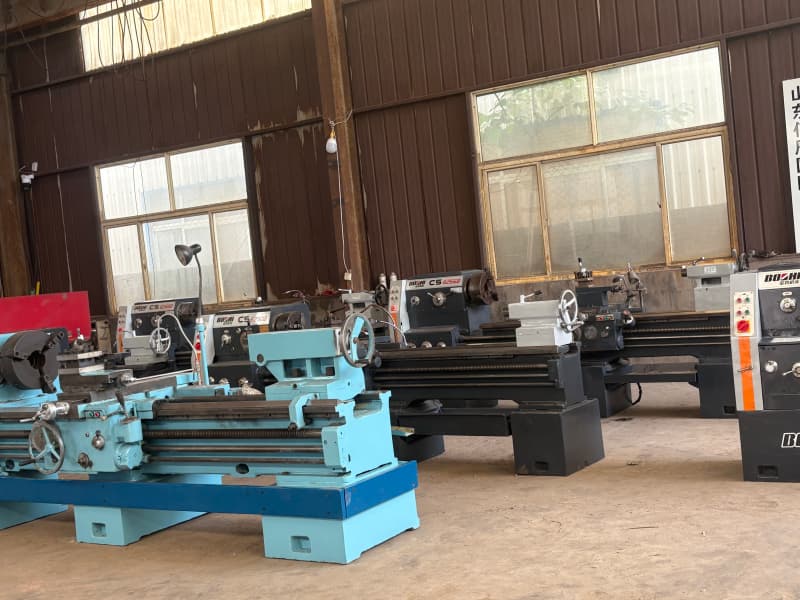


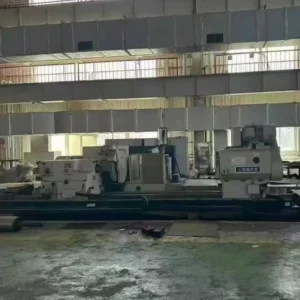
A 3-metre shaft bends away from the tool before the first pass ends. Buy the wrong used lathe and you inherit taper, chatter and scrap for years.
Size a used lathe for long shaft work by distance between centres plus 300 to 500 mm of headroom, check swing over the cross slide, and reject any bed with a wear step in the main turning zone.
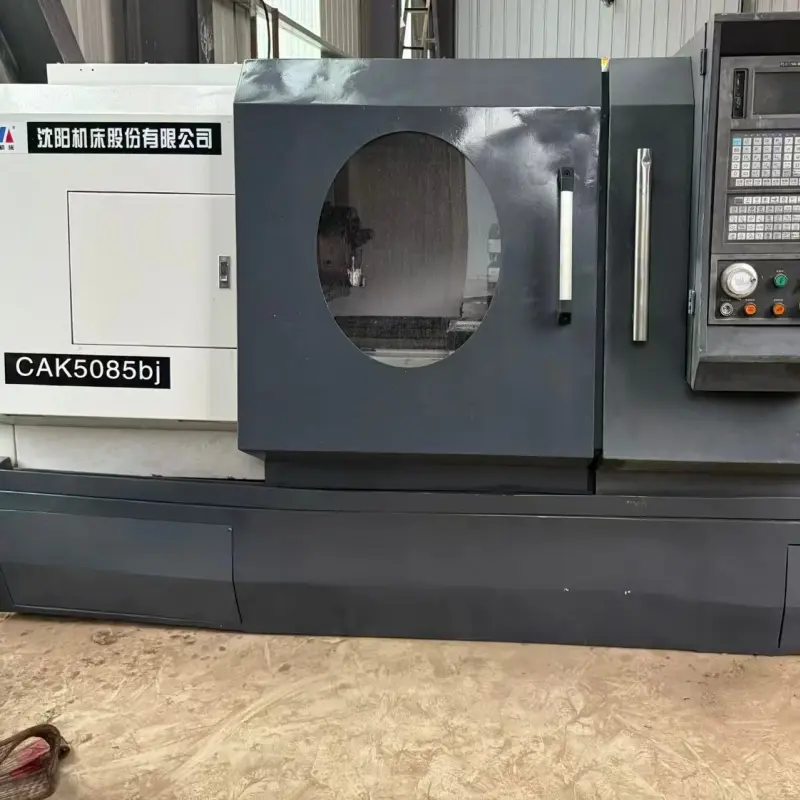
Most buyers who come to us for a used lathe machine for long steel shaft processing have already been disappointed once. They bought on swing diameter, the machine arrived, and the first long shaft came out with a 0.15 mm taper and a surface that looked like fish scales. The machine was not broken. It was simply the wrong shape for the job, and nobody checked the three numbers that matter when the workpiece is longer than it is wide.
What Swing and Centre Distance Do You Actually Need?
Catalogues quote swing over the bed because that number is big and impressive. Long shafts fail on the smaller numbers that nobody prints in the headline.
You need distance between centres at least 300 mm longer than your longest shaft, swing over the cross slide larger than your largest finished diameter plus tool clearance, and a spindle bore that matches your bar stock.
Start From the Drawing, Not the Catalogue
I ask every buyer for three numbers before we discuss a single machine: the longest shaft length, the largest finished diameter, and the smallest diameter on that same shaft. The third number is the one people forget, and it decides whether the job runs smoothly or turns into a fight.
A shaft with a 70 mm journal at one end and a 30 mm section in the middle is not one workpiece. It is two. The thin section has a length-to-diameter ratio that may be three times higher than the thick end, so it deflects first and it chatters first. When I look at a shaft drawing, I calculate L/D separately for every diameter step. The worst step sets the requirement for steady rests, cutting strategy and spindle speed. This is the single most useful habit I can pass on, and almost no buyer does it before enquiring.
Deflection scales with the fourth power of unsupported length. That is not a small effect. Double the free span and the shaft bends sixteen times as far under the same cutting force. It explains why a lathe that turns a 1-metre shaft beautifully can produce scrap on a 2-metre shaft of the same diameter, on the same machine, with the same tool.
| Length-to-diameter ratio | How the shaft behaves | Support you need |
|---|---|---|
| Under 10:1 | Stiff, behaves like normal work | Chuck and tailstock are enough |
| 10:1 to 20:1 | Visible deflection at mid-span, taper starts | One steady rest, reduced depth of cut |
| 20:1 to 40:1 | Chatter, barrel shape, waisted middle | Steady rest plus follow rest, light finishing passes |
| Over 40:1 | Whipping, real safety risk, poor finish | Multiple rests, floating centre, segmented cutting |
The Number That Actually Stops You
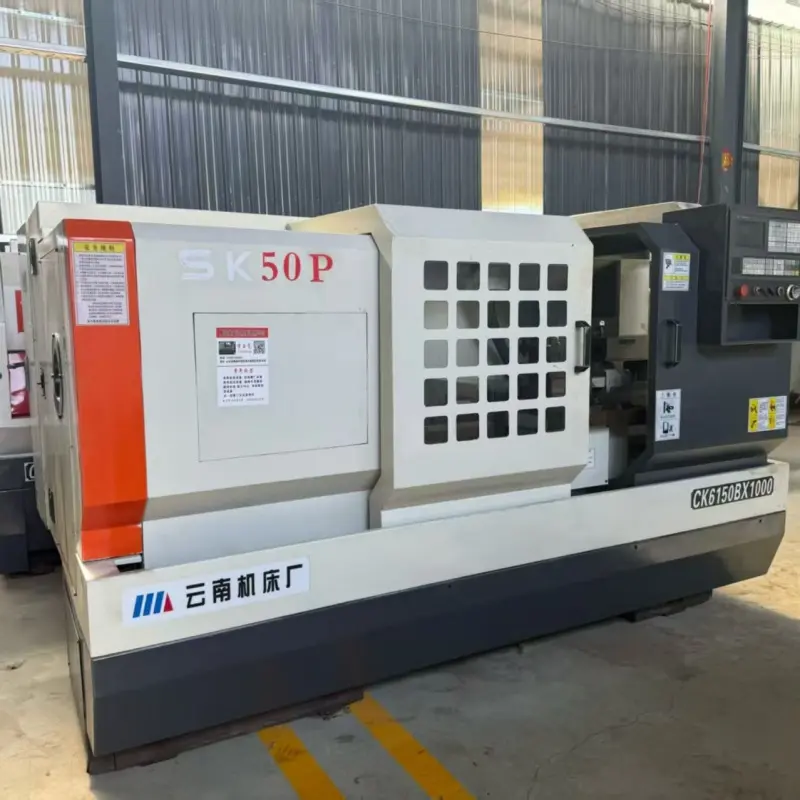
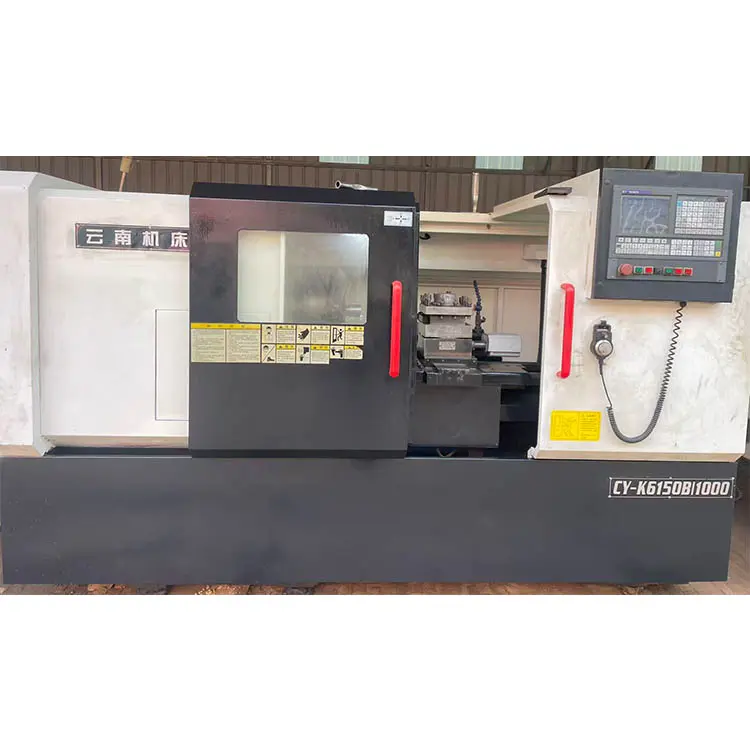
Swing over the bed is the diameter that clears the ways with nothing mounted. Swing over the cross slide is what you get once a tool post, a turret or a four-way holder is bolted down, and it is typically 200 to 280 mm smaller on a 630 mm class lathe. A CW6163C is rated 630 mm over the bed but only about 350 mm over the tool post. If your shaft has a 400 mm flange on one end, that machine will not turn it no matter what the catalogue says.
Then there is length. Bed length is not turning length. The chuck body, the jaw projection, the tailstock quill and any steady rest all consume space between centres. On a 3000 mm machine with a 250 mm chuck fitted, I plan on roughly 2,600 to 2,700 mm of genuinely usable length. Add 300 to 500 mm of headroom on top of your longest part so the carriage can retract, the tool can clear, and the operator is not working with his hip against the tailstock.
Spindle Bore and Bar Work
If you feed bar stock through the headstock, the bore is a hard limit. Common Chinese lathes in this class run 82 mm, 100 mm or 130 mm bores, and the bigger bore usually comes with a heavier spindle nose and a different chuck mounting. Check the actual bore, not the spindle nose thread. I have seen a buyer order a machine believing it had a 130 mm bore because the nose looked large, then discover the through-hole was 82 mm.
How Do You Detect Bed Wear Before You Pay?
Fresh paint hides a worn bed. A 0.05 mm step under the saddle shows up as taper on every long shaft you turn, and rescraping the ways costs more than the machine is worth in many cases.
Sweep a dial indicator along all four way surfaces with the base mounted on the saddle, and reject the machine if you see a step change larger than 0.02 mm or a dip concentrated where the carriage normally works.
The Saddle-Mounted Indicator Sweep
This is the highest-yield test in the whole inspection, and it takes twenty minutes. Clamp a magnetic base to the saddle, not to the bed. Put a 0.01 mm or finer indicator plunger on the front V-way near the headstock. Zero it. Then push the carriage by hand along the full travel at a steady rate, reading the dial every 150 mm, and repeat on the rear V-way and both flat ways.
A good bed produces a smooth curve. A worn bed produces a step. Any change over 0.02 mm across a short distance means a ridge has been scraped into the surface or the ways have worn unevenly, and the carriage is now riding on a ramp. That ramp is what turns a straight shaft into a tapered one. On long work the error compounds, because the tool height changes as the saddle climbs and falls, and the effective depth of cut changes with it.
Where the wear sits tells you how the machine was used. Heavy wear close to the headstock usually means years of short, heavy chucking work. A saddle-shaped dip in the middle of the bed usually means long shaft and threading work, because that is where the carriage lived. The second pattern is worse for you. You are buying the machine precisely for that zone, and you will be cutting in the deepest part of the dip.
Spindle and Tailstock Sit on the Same Axis
Mount a test bar in the spindle taper and indicate it 100 mm and 200 mm from the nose. Under 0.01 mm at 100 mm is a reasonable pass for a used machine in this class. Anything growing non-linearly with distance suggests a bent bar or a damaged taper, not just bearing wear.
Then check the tailstock. Mount a dead centre in the spindle, bring the quill up, and indicate the quill against it. Both parallel offset and angular offset matter, because you are turning between centres. A tailstock that sits 0.05 mm high will produce a shaft that is fat in the middle and correct at the ends. That is the “barrel” defect, and operators often blame the tool or the material for months before anyone checks the tailstock.
The Oil Tells You the History
Drain a sample from the headstock and the apron. Clean oil with a faint amber colour is fine. Milky oil means water has entered, and water in a gearbox means rust on the gears and bearings you cannot see. Metallic glitter means wear is active right now. Both are reasons to walk away, because the repair cost is unpredictable and the damage is already done.
| Inspection item | Pass signal | Fail signal | Repair exposure |
|---|---|---|---|
| Bed way sweep | Smooth curve, under 0.02 mm deviation | Step change or mid-span dip | Rescraping, high cost |
| Spindle runout | Under 0.01 mm at 100 mm | Growing runout with distance | Bearing or spindle work |
| Tailstock alignment | Quill indicates true to spindle centre | Offset high, low or angular | Alignment and rebuild |
| Cross-slide backlash | Adjustable, consistent along travel | Excessive play, tight spots | Nut, screw or gib repair |
| Headstock oil | Clean, amber, no glitter | Milky or metallic | Unknown internal wear |
| Leadscrew | Smooth rotation, no tight spots | Binding or damaged thread | Screw and half-nut replacement |
Which Machine Features Actually Help With Slender Shafts?
Two lathes can have identical capacity plates and behave completely differently on a 2.5-metre shaft. The difference is in the accessories and the low end of the speed range.
A used lathe for slender shaft work needs a steady rest that matches your shaft diameter, a follow rest if you plan to finish-pass long sections, a low spindle speed below 30 rpm, and a live centre that can absorb thermal growth.
Steady Rest and Follow Rest Do Different Jobs
Buyers use these two words interchangeably and they should not. A steady rest bolts to the bed and stays where you put it. It creates a fixed support point, cutting the unsupported span and killing mid-span deflection. Two steady rests on a 1.5-metre shaft at 15:1 ratio have been measured to cut deflection by up to 70 percent. That is the difference between a part that passes inspection and a part that gets remade.
A follow rest mounts on the carriage and travels with the tool, supporting the shaft right behind the cutting edge. It suppresses the deflection caused by the cutting force itself, at the exact point where that force is applied. One published trial on titanium shafts found a follow rest cut deflection by roughly half and improved surface finish by about 30 percent. For finishing passes on long sections, the follow rest does more work than the steady rest.
Practical rule from our shop: for L/D between 20 and 40, run the follow rest for roughing and both rests for finishing. Above 40, add a second steady rest and cut in segments from the tailstock back toward the chuck, so the unsupported length never grows ahead of the tool.
Low Speed Matters More Than High Speed
Slender shafts have a natural frequency, and if you hit it the shaft sings. That is regenerative chatter, and it leaves a regular wave pattern on the surface that no amount of tool sharpening will remove. High spindle speed does not fix it. A stable mid-range speed plus a spindle speed variation function, if the machine has one, breaks the wave pattern far more reliably.
So check the bottom of the speed range, not the top. A lathe that bottoms out at 40 rpm is difficult on a 200 mm diameter shaft where you want surface speed around 30 m/min. Look for a machine that reaches down to 10 to 20 rpm. Also run the spindle at the lowest speed during inspection and listen. Gear noise at low speed under no load is a bad sign, because that is the gear pair you will live in.
Accessories Are Half the Machine
A used lathe sold without its steady rest is a bargain that is not a bargain. Steady rests are matched to the bed width and the centre height, and a replacement for a 630 mm class machine is not a cheap or quick purchase. The same applies to the follow rest, the faceplate, the large chuck, the taper attachment and the change gear set.
I keep a mental list and I check it physically every time: steady rest, follow rest, three-jaw and four-jaw chucks, faceplate, centres, tool holders, thread dial, change gears, coolant pump. On a machine that is missing three of those, I price the replacements before I quote, because the buyer will pay for them either way.
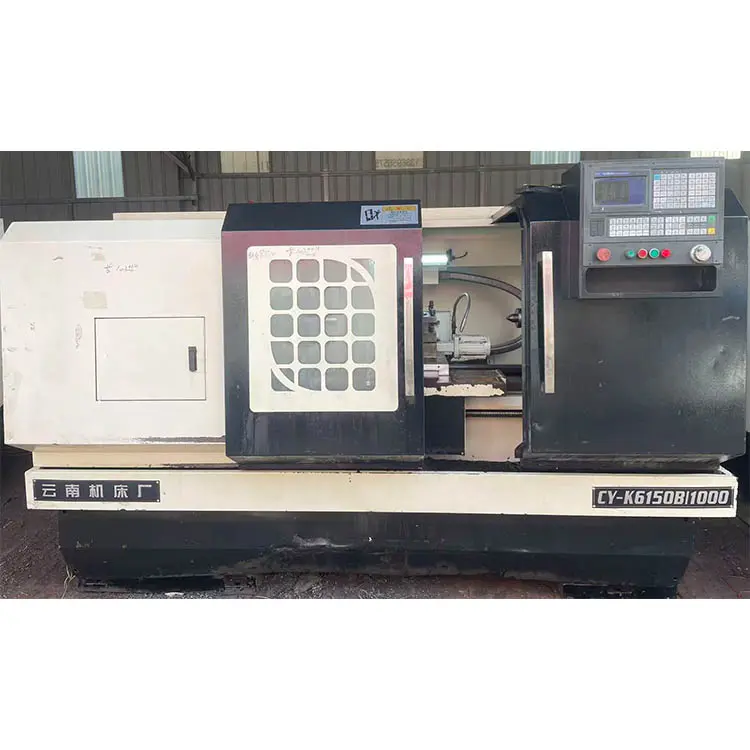
| Specification | CW6163C, 1500 mm | CW6163C, 3000 mm | CW6280B, 3000 mm |
|---|---|---|---|
| Swing over bed | 630 mm | 630 mm | 800 mm |
| Swing over tool post | 350 mm | 350 mm | 480 mm |
| Distance between centres | 1500 mm | 3000 mm | 3000 mm |
| Bed width | 550 mm | 550 mm | 550 mm |
| Spindle bore | 100 or 130 mm | 100 or 130 mm | 100 or 130 mm |
| Spindle speed range | approx. 7.5 to 1000 rpm | approx. 7.5 to 1000 rpm | approx. 5.4 to 720 rpm |
| Main motor | 11 kW | 11 kW | 15 kW |
| Best fit for shaft work | Up to 1.2 m shafts | 1.5 to 2.7 m shafts | 1.5 to 2.7 m, heavier sections |
| Typical domestic asking price | CNY 35,000 to 45,000 | CNY 35,000 to 56,000 | CNY 60,000 and up |
Those price bands are domestic Chinese asking prices from dealer listings and they exclude export packing, inland transport to port and freight. A Gulf buyer comparing a Dammam-delivered price against a Chinese domestic listing is comparing two different things, and the gap is usually packing, crating and ocean freight rather than the machine.
How Do You Prove the Machine With a Test Cut?
Every number on a dial indicator is a proxy. The only proof is a cut, and a seller who will not run one is telling you something.
Bring a bar of your own material, turn three sections at different points along the bed, and measure diameter at each end and in the middle. A taper under 0.03 mm over 500 mm is a good result for a used machine of this class.
Cut a Bar You Brought With You
I ask buyers to send a piece of the actual steel they will run. Not a shiny test bar, not aluminium. If the job is 4140 or a 316 stainless, the test cut should be 4140 or 316, because that is what will show chatter and tool wear honestly. A machine that turns mild steel cleanly can still complain on stainless at the same parameters.
Set up the way you would in production: same chuck, same centre, same steady rest position. Take a roughing pass, pause, then a finishing pass. The pause matters. Residual stress in cold-drawn or hot-rolled bar releases when you remove material, and a shaft that measures true immediately after the cut can bow 0.05 mm after it cools. If the seller will let the part sit for twenty minutes before final measurement, that tells you the machine has been used for real shaft work and the operator understands it.
Measure Taper at Both Ends and in the Middle
Measure at the headstock end, the middle and the tailstock end. Three numbers tell you three different things. A steady taper from one end to the other points at bed alignment or bed twist. A fat middle points at tailstock height or bed wear in the centre. A diameter that changes only where the steady rest was sitting points at rest alignment, which is a setup problem and cheap to fix.
Write the numbers down. A verbal “it cuts fine” is worth nothing in a negotiation, and it is worth nothing six months later when you are trying to work out whether the machine changed or your parts did. The buyers who get the best outcomes from us are the ones who arrive with a notebook, a dial indicator and a 500 mm bar in a wooden box.
Plan for the First Month
Assume the machine will need levelling, a gib adjustment and possibly a new set of way oil lines. On a used lathe, that first-week work is normal and not a defect. What is not normal is discovering the bed needs rescraping, because that is a machine rebuild, not a commissioning task. Sorting those two categories before you pay is the whole point of the inspection.
We have shipped lathes to buyers in Vietnam, Thailand, Malaysia and Saudi Arabia, and the ones that go smoothly are never the cheapest machines. They are the ones where somebody measured the bed, ran the spindle, checked the tailstock and cut a bar before the deposit went out. One buyer in Dammam told us he had bought twice before from other suppliers and received machines that did not match the photos. The third time he asked for a video of the test cut and the indicator readings, and that order was the one that worked. That is not a complicated lesson, but it is one most buyers learn the expensive way.
If you are comparing several machines and want to understand how condition language translates into real measurements, our guide to used lathe machine inspection covers the same checks in more detail. You can also see what is currently on the floor in our used lathe machine inventory or read how we handle export packing and loading before shipment.
Conclusion
Match the machine to your worst diameter step, measure the bed before you pay, and prove it with a cut. That is the whole selection process.