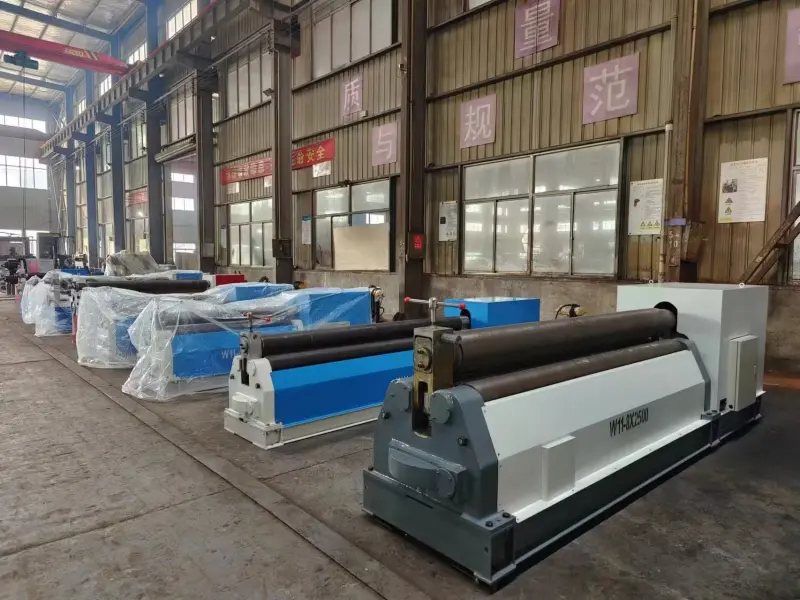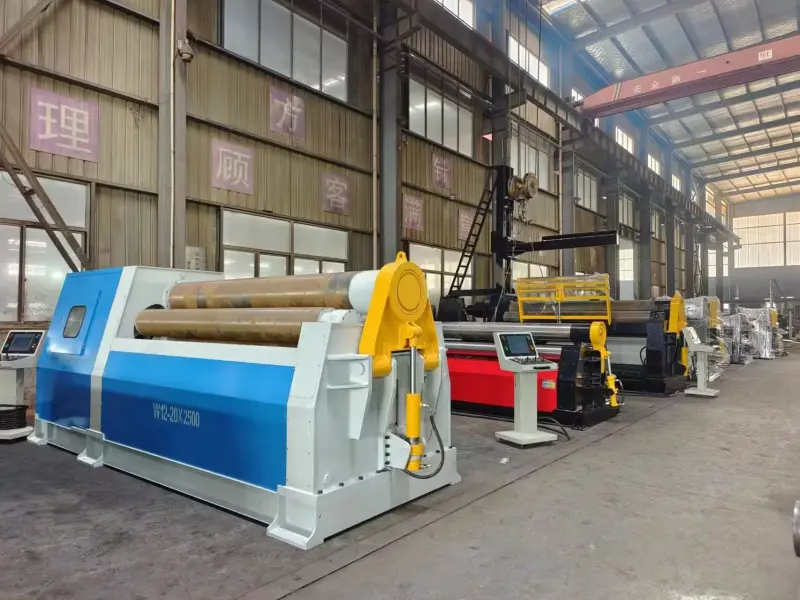


Thick plate fights back. Roll it wrong and you get a barrel-shaped shell, a straight seam and a scrapped plate. Here is how the three rolls actually form steel.
A three-roll plate rolling machine forms thick plate by pinching it between a top roll and two driven bottom rolls, then lowering the top roll slightly on each pass. Both edges must be pre-bent first, and steel springs back after every pass.
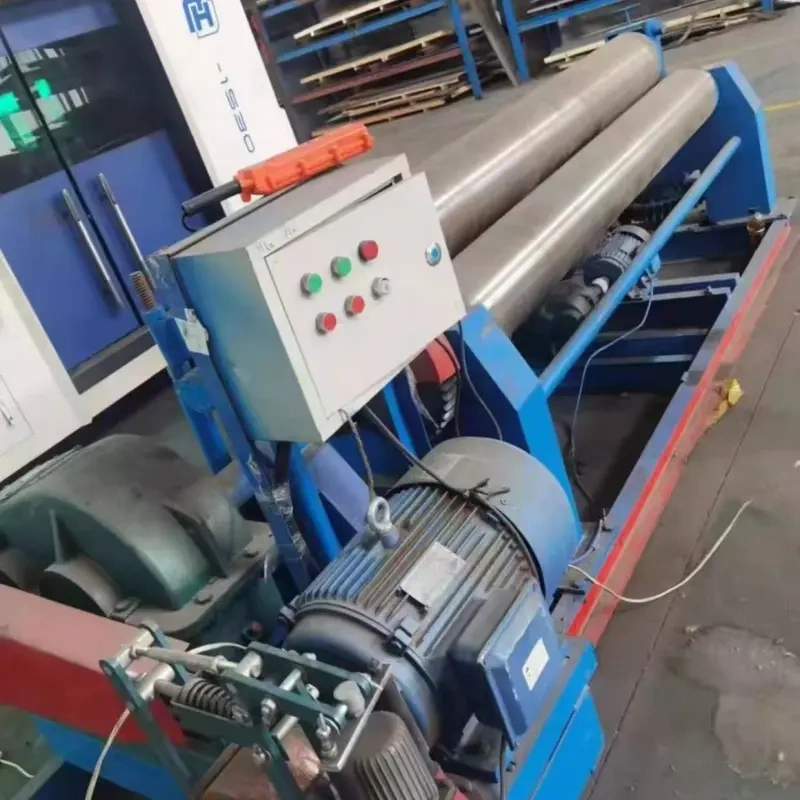
Most buyers I talk to at azmachines start with one number: the maximum thickness on the nameplate. That number is real, but it is only the first gate. A 20 mm machine will not roll every 20 mm plate you put in front of it, because thickness alone does not describe the load. You also have to know the plate width, the yield strength, the final diameter and how much straight end the drawing can tolerate. Change any of those four and the same machine behaves like a different machine.
So let me walk through the process the way I see it on our floor in Liaocheng. I will explain what the rolls do physically, why the edges are the hard part, what the common failures look like, and how to check a used machine before you wire money abroad.
How Do Three Rolls Turn a Flat Plate Into a Curve?
Three rolls do not bend steel by force alone. They bend it by geometry. Get the geometry wrong and thick plate simply stays flat.
The top roll pushes the plate down between two bottom rolls. Because the plate is supported at two points and pushed at a third, it must curve. The depth of that push sets the radius.
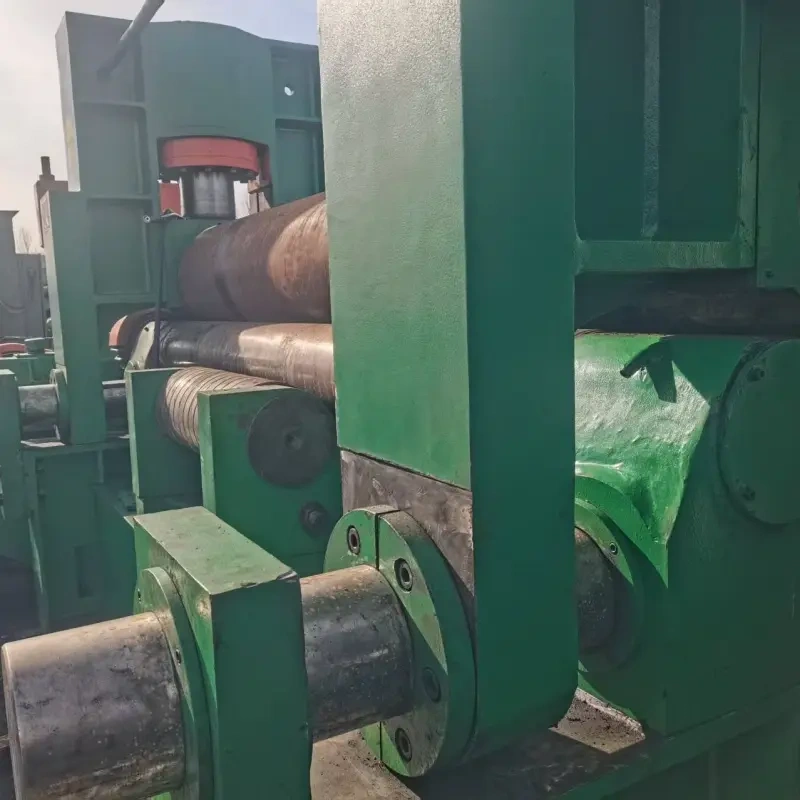
The Bending Moment Comes From Three Contact Points
Think of the plate as a beam. Put two supports under it and press down in the middle, and the beam bows. A plate roll does exactly that, except the beam is 6 metres long, 20 mm thick, and the press never stops moving.
The top roll is the pressing point. The two bottom rolls are the supports. The distance between the two bottom rolls is fixed on a symmetric machine, so the only variable the operator has is how far the top roll comes down. That vertical position is the whole control system on an old mechanical machine. On a hydraulic or NC machine, the same position is set by cylinder stroke and read on a digital display.
Two things happen at once. The driven bottom rolls pull the plate forward through friction, and the top roll forces the plate to follow a curved path instead of a straight one. The plate leaves the forming zone curved, but not as curved as the roll setting suggests. That gap is springback, and it is the reason the first pass never produces the final radius.
I always tell buyers to watch a machine run before they read a spec sheet. You can hear whether the drive is straining and you can see whether the plate advances smoothly or stutters. A plate that stutters is slipping, and slipping means the friction grip is not enough for that thickness and width.
Each Pass Adds Curvature, Not the Whole Radius
Nobody rolls a thick shell in one pass. On most standard machines, a single pass should reduce the radius by no more than 15 to 20 percent of the current radius. Push harder and three bad things happen together: the plate slips, the top roll deflects, and the surface takes marks that no amount of grinding will hide.
A 20 mm plate going to a 1000 mm radius usually takes four to six passes, plus the two pre-bend passes at the edges. That is why cycle time on thick plate is measured in minutes per shell, not seconds. When a seller promises a very fast cycle on thick plate, ask what diameter, what width, what grade and how many passes. The answer usually explains the speed.
Symmetric, Asymmetric, Double-Pinch and Variable Geometry
The label “three-roll” covers four quite different machines. This matters a lot in the used market, because two machines with the same thickness rating can behave completely differently on the floor.
| Arrangement | How the rolls move | Best fit | What to verify |
|---|---|---|---|
| Symmetric / pyramid | Top roll moves down between two fixed bottom rolls | General cylinders, curved panels, mixed job shops | Edge pre-bend sequence, plate reversal, residual straight end |
| Asymmetric / initial pinch | Plate is pinched between top and one bottom roll; the third roll supplies bending force | Small to medium work needing a controlled first bite | Usable pre-bend, reversal pattern, cone method |
| Double-pinch | Both side rolls move to pre-bend either edge around the top roll | Cylinders where both edges must be formed in one setup | Exact clamping, minimum diameter, support arrangement |
| Variable geometry | Side rolls move independently in two directions | Thick plate, tight diameters, rerolling, changing job mix | Foundation, control complexity, proven process |
A symmetric pyramid machine is the simplest and the cheapest to keep running. It is also the least forgiving on the edge, because you have to flip the plate to pre-bend the second end. A double-pinch or variable-geometry machine costs more, but it removes handling steps on heavy plate. If you are budgeting, our plate rolling machine inventory is sorted by arrangement so you can price the difference before you decide. Handling is not a small cost. On a 20 mm by 3000 mm plate, one flip needs a crane, two people and time you are not billing.
What Springback Does to Thick Plate
Springback is elastic recovery. You bend the steel past its yield point, release the load, and part of the bend comes back. The amount depends mostly on yield strength and on the ratio of thickness to radius.
| Material | Yield strength | Typical springback at 500 mm radius, 10 mm plate |
|---|---|---|
| Mild steel S235 / A36 | 235 MPa | 8 to 12 degrees |
| Structural steel S355 | 355 MPa | 12 to 18 degrees |
| High-strength steel S690 | 690 MPa | 25 to 35 degrees |
This table explains a problem I see constantly. A buyer tests a machine on mild steel, approves it, then loads S355 or a wear-resistant grade and cannot hit the diameter. The machine is fine. The springback is different, and nobody re-set the roll positions for the new grade.
On a manual machine, the operator compensates by over-bending and checking with a radius template between passes. On an NC or CNC machine, the compensation can be stored as a recipe per material and thickness. That recipe storage is worth real money to a shop that switches grades often, and it is one of the first things I check when a customer asks whether a used CNC plate roll is worth the premium over a manual one.
Why Does Pre-Bending Decide Whether the Shell Closes?
A rolled shell fails at the seam, not in the middle. The straight strip left at each plate edge is what ruins the weld gap.
Pre-bending forms the last 80 to 200 mm of each plate edge before the body is rolled. Without it, a straight section stays at both ends and the cylinder cannot close to the target radius.
The Straight End Is Geometry, Not Operator Error
The plate cannot be bent right at the edge, because at the edge there is nothing on the far side for the roll to push against. The unbent length is set by the distance between the top roll centre and the bottom roll centres. On a symmetric machine that distance is fixed, so the flat end is fixed too.
This is a geometric fact, not a skill problem. A very experienced operator can reduce it, but nobody eliminates it on a symmetric machine. The usual workaround is to pre-bend each edge separately, either on the plate roll itself with a short bite, or on a press brake before the plate ever reaches the rolls.
On thick plate, the pre-bend is also the heaviest single load the machine sees. The contact area is small and the lever arm is short, so the force per unit area is higher than during body rolling. That is why every honest capacity chart lists two numbers: rolling thickness and pre-bending thickness, with the pre-bend number always lower. If a seller quotes only one thickness and calls it capacity, ask which of the two it is.
How Much Flat End Should You Expect?
The numbers below are the ranges I work with when quoting. They assume normal structural steel at around 235 to 260 MPa yield, and they are a planning guide, not a guarantee.
| Machine type | 10 mm plate | 20 mm plate | 40 mm plate | Pre-bend capability |
|---|---|---|---|---|
| Three-roll symmetric | ~80 mm | ~120 mm | ~200 mm | Needs press brake or repeat passes |
| Three-roll asymmetric | ~40 mm | ~70 mm | ~130 mm | One edge in a single setup |
| Four-roll double-pinch | ~8 mm | ~15 mm | ~30 mm | Both edges in one setup |
You can read the whole buying decision off that table. If your vessel drawing allows a 100 mm straight section at the seam and you are rolling 10 mm plate, a symmetric three-roll machine is enough and you should not pay for a four-roll. If your drawing allows 20 mm on 20 mm plate, a symmetric machine will not get you there no matter who operates it.
The Pre-Bend Pass Is Where Machines Get Hurt
A used machine that has spent ten years pre-bending 20 mm plate has taken a different kind of abuse than one that rolled 6 mm ductwork. The load path is the same, but the peak force is not.
When I inspect a machine, I look at the area around the top roll bearing housings and the frame at the bottom roll pivots. Cracks, repaired welds or fresh paint in a suspicious pattern tell you the machine has been overloaded. I would rather buy a dirty machine with original paint and no weld repairs than a freshly painted one with grinding marks around the bearing seats.
There is also a capacity trap in the used market. Plates get wider, grades get stronger, and machines get pushed past their rating. A machine rated for 16 mm at 2500 mm width will roll 16 mm at 2000 mm width all day, but it will struggle at 3000 mm. Width matters as much as thickness, because the bending moment scales with it and the roll deflection scales with it even faster.
What Goes Wrong on Thick Plate, and What Does It Tell You?
Thick plate exposes every weakness in a machine. The defect you see on the finished shell usually points to one specific mechanical cause.
Oval shells, taper, barrel shape and slippage are the four defects that dominate thick-plate rolling. Each one maps to a different root cause: roll gap symmetry, roll parallelism, roll deflection and friction grip.
Slippage Is Almost Always a Friction Problem
When the plate stops advancing and the rolls spin against it, the drive is not the problem. The grip is. Three things kill grip: too little top roll pressure, contamination on the plate, and a thickness and width combination beyond the machine’s torque rating.
Oil is the sneaky one. Even a thin film of cutting oil can cut the friction coefficient by a large margin, and the operator never sees it because the plate looks clean. Mill scale and rust do the same thing. I tell every buyer the same line: wipe the plate before the test roll, or you will blame the machine for your own handling.
Barrel Shape Is Roll Deflection
A top roll spanning 3000 mm bends under load. The result is a shell that is tighter in the middle than at the edges. The fix on new machines is crowned rolls, slightly larger in the middle than at the ends. On a used machine, you cannot add crown. You can only reduce the load per pass, which means more passes and slower production.
This is why a cheap wide machine is not always a bargain. If you need round shells at 3000 mm width on 16 mm plate, a light-frame machine will fight you every day. A heavier frame with crowned rolls costs more up front and earns it back in passes and scrap.
Taper and Twist Are Alignment Problems
Taper means one end of the shell is tighter than the other. Nearly always that is a roll gap that is not equal left to right, or a plate that was not square when it entered. Twist, where the axis of the cylinder is not straight, comes from the plate feeding at an angle.
Both are correctable. Gap symmetry can be measured with a dial indicator, and most industrial work tolerates less than 0.1 mm difference across the full roll width. Feeding square is a matter of side guides and discipline. What matters for a used-machine buyer is whether the guides still exist, whether the bearings have play, and whether the frame has been twisted by transport or by a bad foundation.
A Defect Table You Can Use on the Floor
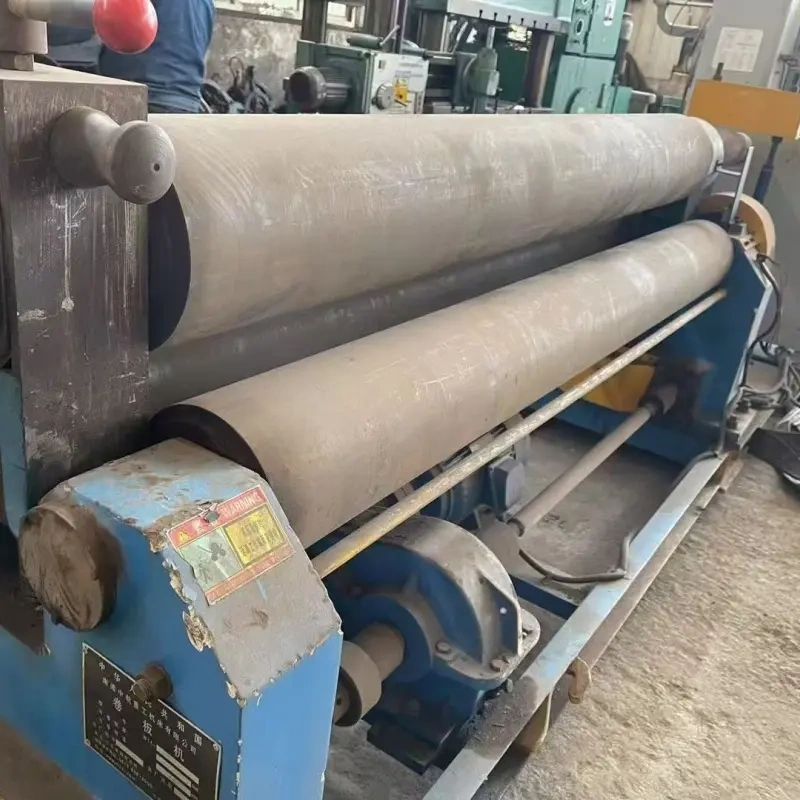
| What you see | Most likely cause | First thing to check |
|---|---|---|
| Shell is oval, seam will not close | Edges not pre-bent, or pre-bend radius wrong | Straight end length at both edges |
| One end tighter than the other | Roll gap not equal left to right | Dial indicator across roll width |
| Tighter in the middle than the edges | Top roll deflection on wide plate | Roll crowning, load per pass, width vs rating |
| Plate slips, rolls spin | Low grip: pressure, oil, scale, or over-capacity | Surface cleanliness, pressure gauge, capacity chart |
| Deep marks or indentations | Scale embedded in roll surface, or overload | Roll surface condition, pressure setting |
| Hydraulic drift mid-pass | Internal leakage in cylinder or valve | Hold test on the pressure gauge |
I have used a version of this table for years when a customer sends photos of a failed shell. Nine times out of ten the photo shows a straight end at the seam, and the conversation moves from “the machine is broken” to “the pre-bend sequence was skipped.”
How Do You Check a Used Three-Roll Machine Before You Pay?
You cannot judge a plate roll by paint, hours or year. You judge it by roll condition, hydraulic hold and one honest test roll.
Check the rolls for wear and scoring, measure left-right gap symmetry, hold hydraulic pressure for 30 minutes, and roll a test plate at the target thickness. Anything the seller will not demonstrate is a risk you are buying.
Rolls First, Paint Last
The rolls are the most expensive wear part on the machine and the hardest to replace. Run your hand along the full working length. Light polishing marks are normal. Deep scoring, pitting, weld spatter or a visible step at the ends is not.
Then measure. A working roll worn past about one percent of its original diameter has lost enough of its crown and roundness to affect shell quality. You will not always have the original diameter, but the nameplate usually gives the top roll size, and a micrometer tells you what is left.
The Hydraulic Hold Test
On a hydraulic machine, pressure is the whole story. Bring the system to working pressure, shut the pump off, and watch the gauge. A drop of more than about 0.5 MPa in ten minutes points to internal leakage in a cylinder or a directional valve. A drop of ten percent over 30 minutes is the usual rejection line in Chinese reconditioning practice.
Oil condition tells you the maintenance culture. Dark, gritty oil means the pump and valves have been eating debris. Fresh oil in a machine with a leaking cylinder is often a cosmetic fix before sale, so look at the fittings and the floor under the machine, not just the reservoir.
Test Roll, Not Test Drive
A machine that turns quietly with no plate in it proves almost nothing. Ask for a test roll at your target thickness, your width and, if possible, your material grade. Then measure the shell: diameter at both ends, roundness at three sections, and the straight length at the seam. If the seller is far away, ask for video of the same test rather than a walkaround clip, and read our inspection checklist for used machinery before you book the trip.
If the seller cannot supply the exact grade, mild steel at your thickness is still useful. You will see slippage, marking, taper and hydraulic drift on mild steel. What you will not see is the springback behaviour of a high-strength grade, so keep that margin in your planning.
| Check | Acceptable result | Walk away if |
|---|---|---|
| Roll surface | Light polish, no steps | Deep scoring, pitting, weld spatter |
| Roll diameter wear | Under 1 percent | Visible step, heavy ovality |
| Left-right gap | Under 0.1 mm difference | Taper appears in a test shell |
| Hydraulic hold | Under 0.5 MPa drop in 10 min | Steady fall on the gauge |
| Frame and welds | Original paint, no repairs | Fresh paint over grinding marks |
| Drop end / release | Opens smoothly under load | Sticking, hydraulic creep |
| Test shell roundness | Within drawing tolerance | Oval, twisted, or open seam |
| Documentation | Nameplate, manual, wiring diagram | No nameplate, no history |
On price, used three-roll machines move in a wide band. A domestic Chinese machine eight to ten years old in good condition typically trades at a fraction of new price, while a European brand with documentation and a proven service history carries a premium of 20 to 30 percent over a comparable domestic unit. I would pay that premium only when the spare parts channel is confirmed in writing. A cheap imported machine with no bearing availability is not cheap.
One more thing from our own warehouse. We keep a short offcut of 12 mm plate near the roll bay, and every machine we take in gets rolled with it before it goes on the listing. It takes twenty minutes. Twice in the past two years that offcut caught a machine with a failing cylinder seal that looked perfect on a dry run. That is the cheapest inspection we do.
Conclusion
Three rolls bend plate through geometry, not force. Pre-bend the edges, respect springback, take light passes, and thick plate behaves.