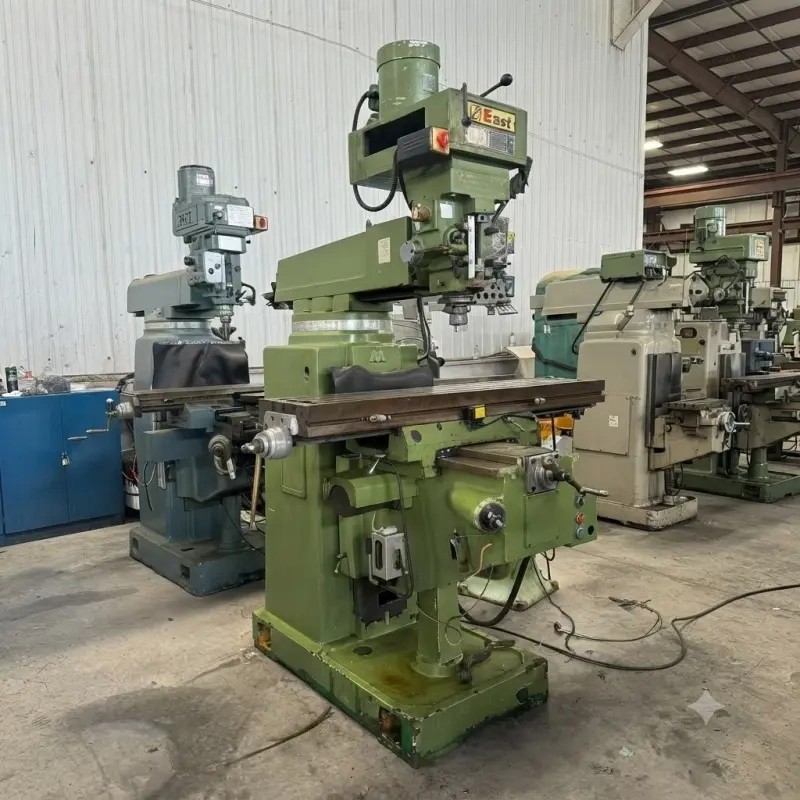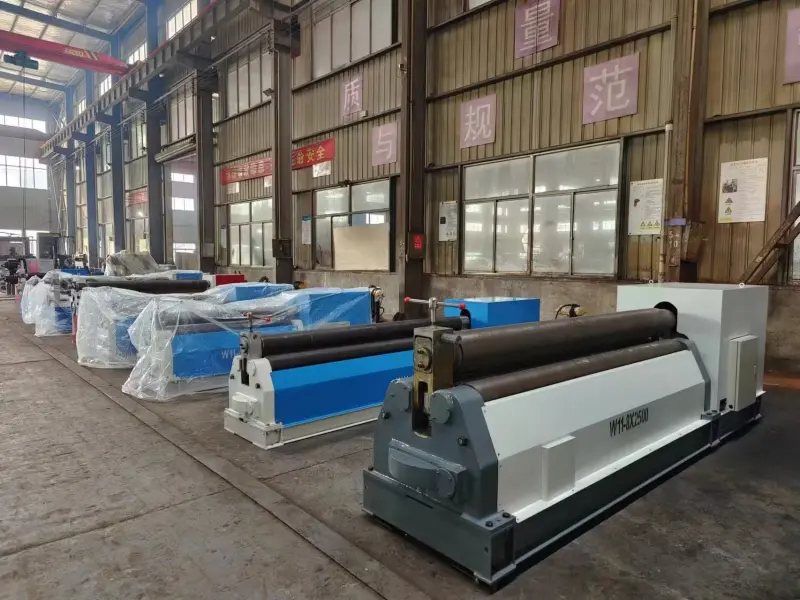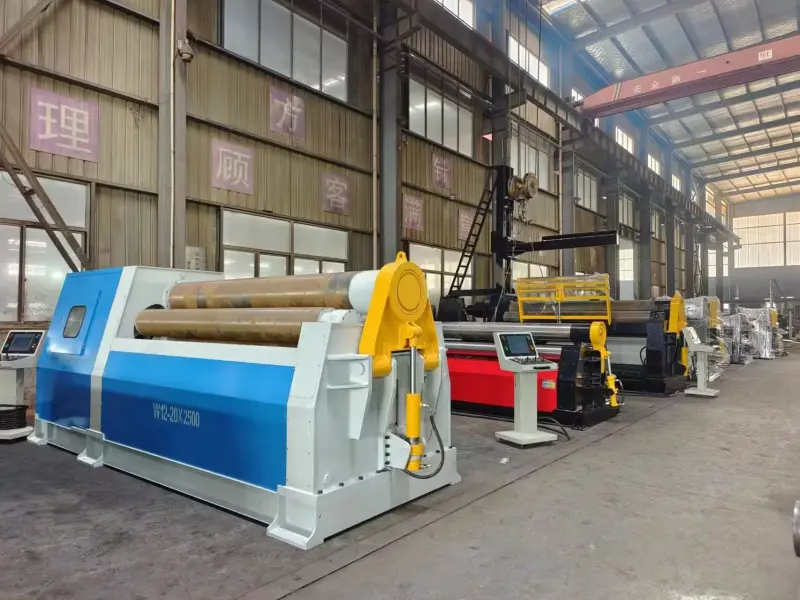


Two plate rolls, same tonnage on paper. One closes a cylinder in one pass. The other leaves straight edges, a crane flip, and extra scrap. Here is how to tell them apart.
A three-roll machine bends plate between a top roll and two bottom rolls, so the plate must be flipped to pre-bend both ends. A four-roll machine adds a clamping roll and two side rolls, pre-bending both ends in one pass with almost no flat edge left.
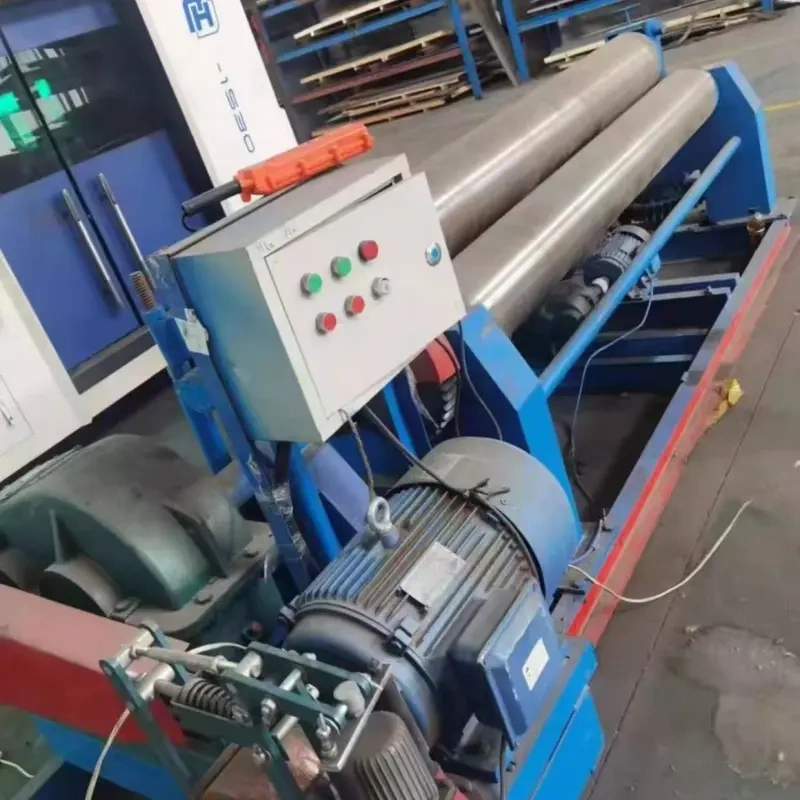
Most buyers compare these two machines on the specification plate and stop there. Thickness, width, motor power, price. That comparison hides the thing that actually decides your cost per cylinder: how much straight plate is left at each end, and how many times a crane has to touch the shell before it closes. I sell both designs out of our yard in Liaocheng, and the argument I have with buyers is almost never about tonnage. It is about whether their shop can live with a flip.
What Do the Roll Configurations Actually Change on a Plate Rolling Machine?
The roll layout decides three things at once: whether the ends can be pre-bent, how the bending load travels through the frame, and whether a control system can repeat a diameter.
Roll count is not the real difference. The real difference is whether the machine can pinch the plate against a fixed clamping roll, because that pinch is what allows both ends to be pre-bent without turning the plate around.
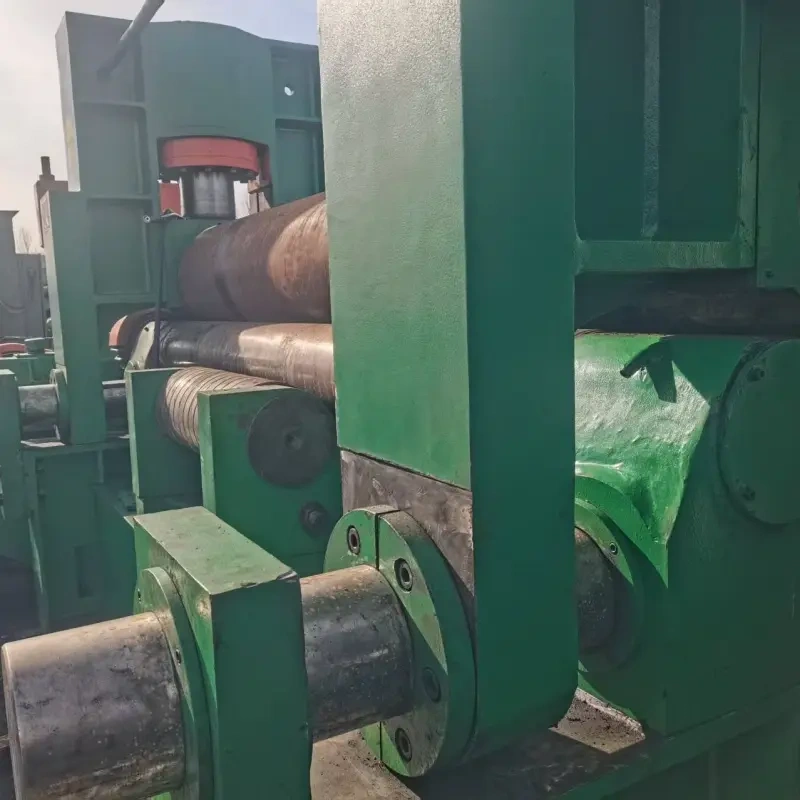
The Three-Roll Pyramid and Its Two Variants
The classic three-roll layout is a pyramid. One top roll sits centered above two bottom rolls that are fixed in the frame. The bottom rolls are driven, the top roll is idle, and a hydraulic or mechanical screw pushes the top roll down. Plate is dragged through by friction and bent over the top roll.
That symmetric version cannot pre-bend. The straight section at each end is roughly half the centre distance between the two bottom rolls. On a small machine like a W11F-6×2000, where the bottom roll centre distance is about 400 mm, you are looking at close to 200 mm of unbent plate per end before you even start.
The asymmetric or initial-pinch version moves the top roll so it sits directly over one bottom roll. A side roll then bends the leading edge down. This gets one end pre-bent properly. To do the other end you lift the plate out, turn it end for end with a crane or a jib, feed it back in, and pre-bend again. The residual straight edge drops to roughly one to two times plate thickness, which is a real gain, but the handling step stays.
What the Fourth Roll Adds
A four-roll machine is not a three-roll with one extra roll bolted on. It is a different load path. There is a top roll, a bottom roll that clamps the plate against it, and two side rolls mounted on curved guides that swing up to bend the plate around the top roll.
The clamp is the whole point. Once the plate is pinched between the top and bottom rolls, it cannot slide sideways or skew. The side rolls then bend the leading edge, the rolls reverse, the trailing edge is bent by the other side roll, and the shell closes. The plate never leaves the machine and never gets flipped. That is why a four-roll can hold a residual straight edge in the region of half a plate thickness to two plate thicknesses depending on how it is set up, while a three-roll symmetric machine is stuck with a straight tangent section no matter how good the operator is.
Load Path, Deflection and Crown
The geometry changes where the force goes. On a three-roll pyramid, all bending force converges on three contact lines, and the top roll carries the whole load across its span. Push a 3,000 mm top roll hard into 20 mm plate and it deflects. The cylinder comes out barrel-shaped, tighter in the middle than at the ends.
Builders fight this with crowned rolls, ground slightly larger in the middle than at the ends. The crown is usually matched to around 75 percent of nominal capacity and to the material the customer rolls most. Get the crown wrong in either direction and you get a shape error: too little crown gives you a barrel, too much gives you an hourglass with a tight waist.
On a four-roll, clamping and bending are separated. The pinch holds the plate, the side rolls apply the bending moment at a point the frame can support more evenly, and the load spreads across the width more cleanly. That is why a four-roll tends to hold roundness better on wide plate without leaning on crown compensation as hard.
| Feature | 3-Roll Symmetric | 3-Roll Asymmetric | 4-Roll Double Pinch |
|---|---|---|---|
| Roll layout | Top roll over two fixed bottom rolls | Top roll over one bottom roll, plus side roll | Top roll, bottom clamping roll, two side rolls |
| Pre-bending | None | One end per loading | Both ends, one loading |
| Plate flip needed | Yes, for both ends | Yes, for the second end | No |
| Residual straight edge | About half the bottom-roll centre distance | About 1 to 2 times thickness | About 0.5 to 2 times thickness |
| Typical plate range | Roughly 3 to 50 mm | Roughly 1.2 to 16 mm | Roughly 4 to 180 mm |
| CNC repeatability | Limited, plate can slip | Limited, plate can slip | Good, clamped plate can be tracked |
| Price versus 4-roll | 20 to 40 percent lower | 15 to 30 percent lower | Baseline |
How Much Flat Edge Does Each Design Leave, and Why Does It Cost You Money?
Flat edge is not a cosmetic defect. It is plate you paid for, cut off, and scrapped, plus a second operation and a weld seam that does not line up.
Flat edge is the unbent tangent section at each end of the plate. A symmetric three-roll leaves the most, an asymmetric three-roll leaves roughly one to two plate thicknesses, and a four-roll can hold it near half a thickness because both ends are pre-bent while the plate stays clamped.
Why the Ends Never Bend
Bending only happens where the plate is in contact with the top roll and supported between the two bottom rolls. Anything shorter than the distance between those support points never enters the bending zone. It just rides through flat.
The fix is pre-bending: you feed the plate in until only a short tongue sticks past the top roll, apply full bending force to that tongue, then advance and roll normally. A three-roll asymmetric machine can do this on one end. A symmetric machine cannot do it at all without a press brake or a dedicated pre-bending die, because there is no side roll to push the tongue against.
On a four-roll, the clamp lets the side roll work very close to the gripped edge. The machine pre-bends the leading edge, rolls, reverses, and pre-bends the trailing edge against the other side roll. No crane, no re-alignment, no second setup.
Reading Flat Edge Numbers Before You Buy
Published flat-edge figures vary because they depend on roll diameter, centre distance and how the machine is set. The pattern is consistent though, and it scales with thickness. These are the sort of numbers I use when a buyer asks what to expect:
| Machine type | 10 mm plate | 20 mm plate | 40 mm plate |
|---|---|---|---|
| 3-roll symmetric | About 80 mm per end | About 120 mm per end | About 200 mm per end |
| 3-roll asymmetric | About 40 mm per end | About 70 mm per end | About 130 mm per end |
| 4-roll double pinch | About 8 mm per end | About 15 mm per end | About 30 mm per end |
Read those numbers as material. If you are rolling a 2,000 mm wide cylinder from 20 mm plate on a symmetric three-roll, you may carry 240 mm of dead length across both ends. Standard practice is to add twice the expected flat edge to each end of your blank and trim after forming with plasma or a flame cut. On carbon steel that is annoying. On 304 stainless at [Zora will replace] per tonne, it is a line item.
What Flat Edge Costs on Stainless
Stainless is where the arithmetic turns against three rolls. The trimmed ring is scrap, the trim cut is a second operation, and the weld prep has to be redone because the edge you carefully bevelled is now in the bin. If you are building dairy tanks, brewery vessels or pharmaceutical shells where the longitudinal seam has to be parallel and clean, a four-roll pays for the extra roll in scrap savings alone.
I have one customer in [Zora will replace] who rolls 6 mm 316L shells at 1,200 mm diameter. He ran the numbers on a used three-roll asymmetric against a used four-roll and bought the four-roll. His scrap rate on the shell blanks dropped enough that the price gap closed inside a year. That is not a universal result. It is what happens when your material is expensive and your diameter is fixed.
Which Checks Decide Whether a Used Roll Is Worth Its Price?
A used plate roll is priced on capacity claims, not on measured capacity. The gap between the two is where buyers lose money.
Check the rated capacity against your actual material first, then the roll surfaces, then the hydraulics. A machine that powers on and turns its rolls is not the same as a machine that will roll your plate to your diameter without stalling.
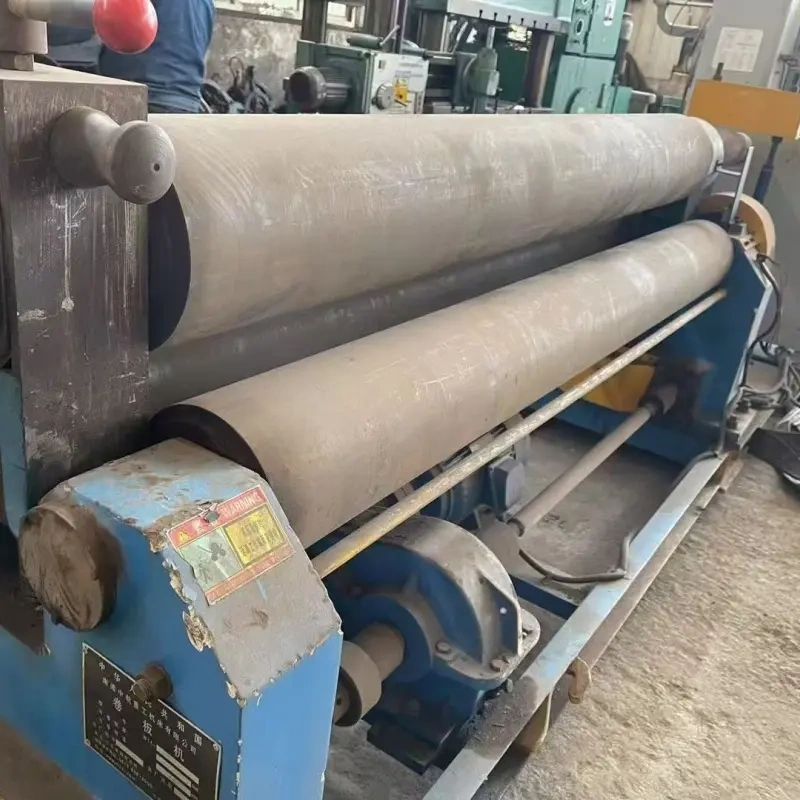
Capacity Is a Claim, Not a Specification
Rolling force scales with thickness squared, with width, with yield strength, and inversely with the diameter you are rolling to. Doubling thickness multiplies the force by roughly four. That is why a nameplate that reads 20×2000 means 20 mm of mild steel at 2,000 mm wide, at a comfortable diameter, at around 245 MPa yield. It does not mean 20 mm of anything.
Derate for material before you pay. A machine rated for 20 mm mild steel will typically roll only 12 to 14 mm of 304 stainless.
| Material | Rough yield strength | Share of mild-steel rating |
|---|---|---|
| Mild steel Q235 / A36 | 235 to 250 MPa | 100 percent |
| Low-alloy Q345 | About 345 MPa | 80 to 85 percent |
| Stainless 304 / 316 | 205 MPa annealed, work hardens | 60 to 70 percent |
| Wear plate, quenched | 700 to 1,200 MPa | 40 to 60 percent |
| Aluminium 5000 / 6000 | 90 to 280 MPa | 120 to 150 percent, watch surface marking |
One more number that catches people: pre-bending capacity is lower than rolling capacity, usually 70 to 85 percent of it. A machine that rolls 30 mm pre-bends about 25 mm. If your job needs a pre-bent 28 mm end, the 30 mm machine is not enough. Always size on the pre-bend column, not the rolling column, then add 20 to 30 percent margin.
Roll Surface, Bearings and Hydraulic Sag
Put a micrometer on each roll in three places, both ends and the middle. You are looking for a step or a taper, not just absolute size. A polished roll face with no casting pits is a good sign. A roll with a visible wear band where most plate has run is a machine that has done a lot of narrow work, and the band will print onto your shells.
Then run the hydraulics. Raise the top roll to a mid position, hold it, and watch the gauge for ten minutes. Pressure that creeps down means a leaking seal or a tired valve. On a three-roll, check that both ends of the top roll come down together. Uneven descent tilts the top roll and rolls a cone instead of a cylinder, and no amount of operator skill fixes a tilted roll. On a four-roll, watch both side rolls travel through their arc together and listen for a groan from the guides.
Controls, Encoders and Repeatability
This is where used four-roll machines separate from used three-roll machines with a CNC sticker on them. A three-roll cannot hold a diameter program reliably because the plate can slip between the rolls, so the encoder never knows exactly how much material has passed. A four-roll clamps the plate, so the encoder can track the feed and the stored program reproduces the diameter batch after batch.
If you are buying a used NC or CNC machine, ask for three consecutive shells from the same program and measure them. If the seller cannot produce that, price the machine as a manual machine with a digital readout, because that is what you are getting.
Before you sign, test roll one cylinder on your own plate at your own minimum diameter. Measure the roundness, measure the flat edge at both ends, and measure the diameter at the middle and at both ends to see the crown effect. That single test tells you more than an hour of conversation.
Which Machine Fits Your Shop: Job Shop, Tank Fabricator or Vessel Line?
The right answer depends on how often you flip a plate, not on which machine is better built.
Buy a three-roll when rolling is one task among many and the flip is not your bottleneck. Buy a four-roll when cylinders are a repeat product, when crane time is expensive, or when the weld seam has to be parallel and code-compliant.
The Flip Is the Hidden Cost
A flip is not one movement. It is unclamping, lifting a shell that may weigh several tonnes, turning it, re-aligning it square to the rolls, and re-establishing the pre-bend. Every one of those steps has a labour cost and a safety exposure. On thick plate the shell is heavy enough that the crane work becomes the riskiest part of the job.
Fabricators running repeat cylinders on a four-roll commonly report 40 to 60 percent more throughput than manual three-roll work, simply because the flip and reload disappear. In high-production shops that usually pays back the price premium inside 18 to 24 months. In a shop rolling two shells a week, it never pays back, and the three-roll is the correct purchase.
When Three Rolls Still Wins
Three rolls still win in a mixed job shop. Short runs, odd materials, cones, thick plate at large diameters, one experienced operator who knows the machine. A symmetric three-roll with a press brake next to it can pre-bend ends on the brake and roll on the rolls, and that combination is cheaper than a four-roll of the same capacity.
Budget matters too. For comparable capacity, a three-roll costs roughly 20 to 40 percent less than a four-roll, and in the used market that gap is wider because four-roll machines hold their value. In the Chinese used market a 20 mm × 2000 mm three-roll typically trades around RMB 60,000 to 85,000 [Zora will replace], while a heavy CNC four-roll at 3,000 mm × 50 mm can start near USD 80,000 new and hold most of that as a used machine.
| Your situation | Better fit | Why |
|---|---|---|
| Mixed job shop, low volume, varied materials | 3-roll symmetric | Cheapest per tonne, pre-bend on a press brake |
| Light sheet, HVAC, small tanks under 16 mm | 3-roll asymmetric | Low cost, decent flat edge, small footprint |
| Repeated cylinders, same diameter, daily runs | 4-roll double pinch | No flip, repeatable program, less scrap |
| Pressure vessels, code weld seams | 4-roll double pinch | Short flat edge, parallel seam, consistent roundness |
| Thick plate over 30 mm at large diameter | 3-roll symmetric or 4-roll heavy | Depends on handling capacity, not flat edge |
| One operator, tight floor space, tight budget | 3-roll | Simpler to maintain, cheaper parts |
One last thing I tell every buyer who asks me this question. Do not buy the biggest machine you can afford. Buy the machine that covers your most common job plus a sensible margin, and put the saved money into a test cylinder on your own plate before you pay. I have seen a shop buy a 4-roll that was two sizes too big for its work and then lose money on every small shell because the rolls were too large to close a tight diameter. The top roll diameter sets the minimum cylinder you can form, at roughly 1.1 to 1.5 times that diameter. A big roll is not a flexible roll.
Conclusion
Roll count decides pre-bending, flat edge and repeatability. Match the layout to how often you flip a plate, then verify capacity on your own material before you pay.