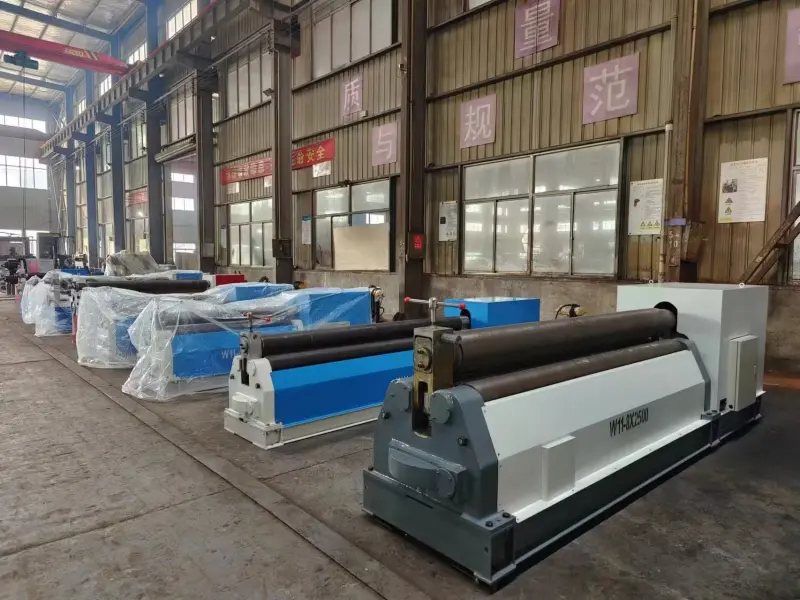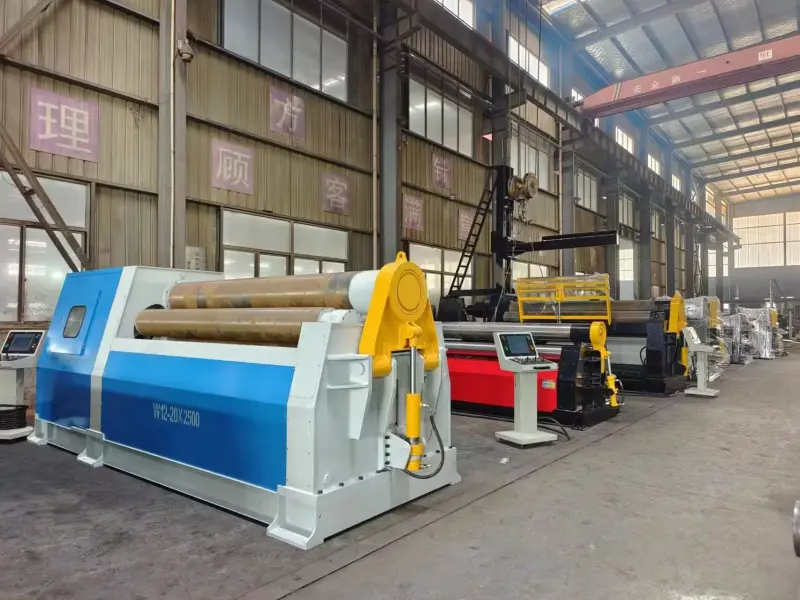


A buyer signs for a 20 mm plate roll and finds it cannot pre-bend his stainless ends. The saving disappears in one weld seam. Here is how we size capacity first.
Matching a used plate rolling machine to a customer means converting his worst job into an equivalent mild-steel thickness at full width, adding a 20 to 30 percent margin, then checking the pre-bend rating and the minimum cylinder diameter the rolls can actually close.
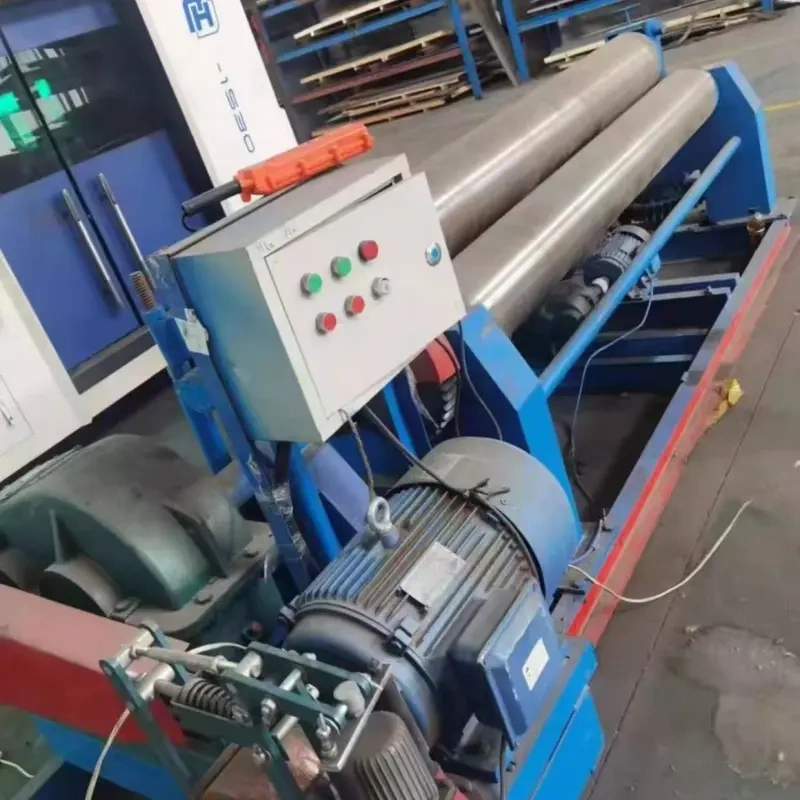
Most buyers start a plate roll search the same way. They look at a price list, find a machine that fits the budget, and compare nameplate numbers that look similar. Then the machine lands on the floor and the first real job exposes the gap. A shell that will not close at the seam. A pre-bent edge that springs back. A full-width plate that stalls the rolls halfway through the pass.
We sell used plate rolling machines every month, and the conversations that go wrong are almost never about condition. They are about capacity that was never calculated. This case is a good example, because the buyer arrived with a machine size in mind and left with a different one. The difference was not sales talk. It was arithmetic.
What Does a “20 × 2500 mm” Rating Actually Mean on a Used Plate Roll?
The nameplate number is a mild-steel promise at a generous diameter. It says nothing about your stainless, your full width, or your 600 mm tank shell.
A rating of 20 × 2500 mm means 20 mm of mild steel near 245 MPa yield, 2500 mm wide, rolled to a comfortable diameter. Change the material, the width or the diameter and the real capacity drops.
The Three Numbers Behind Every Capacity Claim
Rolling is not a single force. It is a bending moment applied along a line, and three inputs decide how much of it you need. Thickness is the section that has to yield. Width is the lever length. Yield strength is the material’s resistance to being bent at all.
The relationship is simple enough to hold in your head. Rolling force scales with thickness squared, with plate width, and with yield strength, and it falls as the target diameter grows. Written out, F is proportional to t² × W × σy ÷ D. That squared term is why thickness dominates every conversation. Double the plate thickness and you roughly quadruple the force the frame, the rolls and the hydraulic cylinders have to carry.
Width behaves in a straight line, which makes it easier to underestimate. A 2500 mm plate asks for twice the total moment of a 1250 mm plate at the same thickness. The frame does not care that the narrow strip rolled easily last week.
Yield Strength Is Where Most Quotes Go Wrong
Every published capacity is quoted against a reference yield strength, usually 245 MPa for Chinese W11 and W12 series machines. Buyers read the number, then apply it to whatever plate is on the drawing. That is the most expensive mistake in this category.
The correction is a square root, not a straight percentage. Take the rated thickness, multiply it by the square root of the rated yield divided by the actual yield. A machine rated 6 mm at 245 MPa, asked to roll 1200 MPa wear plate, lands at roughly 6 × √(245 ÷ 1200), which is about 2.7 mm. Quoting that machine for 6 mm Hardox is not optimistic. It is a cracked weld waiting to happen.
| Material | Reference yield strength | Practical share of the mild-steel rating | What that means on a 20 × 2500 machine |
|---|---|---|---|
| Mild steel Q235 / A36 | 235 to 250 MPa | 100 percent, the rating basis | 20 mm |
| Low-alloy Q345 / S355 | about 345 MPa | 80 to 85 percent | 16 to 17 mm |
| Stainless 304 / 316 | about 205 MPa annealed, work-hardens fast | 60 to 70 percent | 12 to 14 mm |
| Quenched wear plate, 400 to 500 HB | 700 to 1200 MPa | 40 to 60 percent | 8 to 12 mm |
| Aluminium 5000 / 6000 | 90 to 280 MPa | up to 120 to 150 percent | 24 to 30 mm, watch surface marking |
Stainless deserves a second look, because the annealed yield number looks harmless. A 304 sheet starts near mild steel in strength, then work-hardens with every pass. By the third pass the material in the bend zone is stronger than it was on the first, and springback grows with it. That is why the practical figure sits at 60 to 70 percent rather than at the theoretical 85 percent you would calculate from the annealed number alone.
Pre-Bend Sits Lower Than Rolling
Even a correctly derated rolling capacity is not the number that decides your job. Pre-bending the last 100 mm of a plate needs more force per unit length than rolling the body, because there is no long lever of already-curved material helping the bend. Manufacturers rate pre-bend at roughly 70 to 85 percent of rolling capacity.
You can read this straight off a spec sheet. A W12-30 × 2500 four-roll rolls 30 mm and pre-bends 25 mm. A 20 mm class machine commonly pre-bends 16 mm. If your tank shell is 18 mm and every end has to close cleanly, a 20 mm rolling rating is not enough, even though the nameplate says you have margin.
Full Width Is the Only Width That Counts
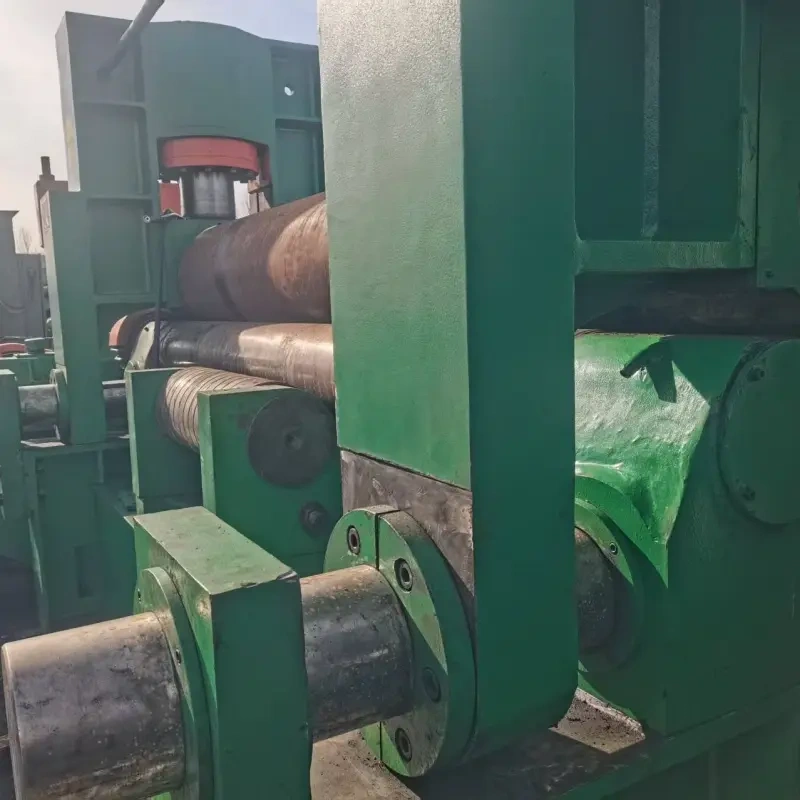
Sellers sometimes quote capacity at a narrow width because the machine looks better that way. A machine that rolls 20 mm at 1500 mm may only manage 14 mm across a full 2500 mm bed. Ask for the capacity at the roll length, not at a convenient strip.
The same logic applies at the small end. The smallest cylinder a plate roll can close is set by the top roll, because the plate cannot wrap tighter than the roll it is bending around. The practical minimum inside diameter runs about 1.1 to 1.5 times the top roll diameter. A W11-20 × 2500 carries a 340 mm top roll, so a 400 mm shell is realistic and a 300 mm shell is a conversation, not a promise. If your product range includes small-diameter pipe or narrow hoppers, give the supplier your smallest finished diameter together with the thickness, and make him confirm the geometry in writing.
How Do We Convert a Real Job into a Required Capacity?
I ask for the worst job, not the average one. Thickest plate, real width, real grade, smallest shell. Then we do arithmetic instead of guesswork.
Take the thickest plate at full width and its actual yield strength, convert it to equivalent mild steel, add 20 to 30 percent, then confirm the pre-bend rating and minimum diameter. That number is the machine you need.
Worked Example: 10 mm Stainless Tank Shells
A fabricator rolls 304 shells at 10 mm thick and 2000 mm wide, with a finished outside diameter of 1200 mm. He has been quoted a 16 mm machine and wants to know if it will do.
Start with an effective strength rather than the annealed figure, because the plate will work-harden during multi-pass rolling. A conservative 400 MPa is a fair working number for 304 in this duty. The equivalent mild-steel thickness is 10 × √(400 ÷ 245), which is about 12.8 mm. Add the 25 percent margin we recommend and the requirement lands near 16 mm.
That looks like the 16 mm machine fits. It does not. The pre-bend rating on a 16 mm class machine is around 13 mm, and the ends are the part that decides whether the seam closes. Moving up one class to a 20 mm machine gives a 16 mm pre-bend, which covers the job with a small cushion. That is the machine I would quote.
| Job | Plate size | Effective strength | Equivalent mild steel | With 25 percent margin | Class to quote |
|---|---|---|---|---|---|
| Stainless tank shell | 10 mm × 2000 mm, 304 | about 400 MPa | 12.8 mm | 16 mm | 20 mm class, 4-roll |
| Structural cylinder | 16 mm × 2500 mm, Q345 | 345 MPa | 19.0 mm | 24 mm | 30 mm class |
| Hopper cone, painted | 8 mm × 2000 mm, mild | 245 MPa | 8.0 mm | 10 mm | 12 mm class |
| Wear liner | 6 mm × 1500 mm, 500 HB | about 1200 MPa | 13.3 mm | 17 mm | 20 mm class, check diameter |
The 20 Percent Margin Is Not Decoration
Buyers often treat the margin as a sales tactic. It is not. Plate is not uniform. Mill tolerance on thickness runs both ways, and a nominally 16 mm plate can arrive at 16.4 mm. Yield strength varies within a single heat. Roll surfaces wear, and a worn roll grips less and deflects more. Operators take an extra pass to chase a radius, and each pass adds work hardening.
The 3 percent thinning rule is a useful second gate. Rolling thick plate into a small diameter stretches the outer fibre. If the calculated thinning at the outside of the bend goes past about 3 percent, the job wants a larger diameter or a different material, not a bigger hydraulic pump.
There is also a human cost to running at the limit. A machine working at 85 or 90 percent of rating gives no room for a mistake, and mistakes on a plate roll show up as a stalled pass with a plate jammed between the rolls. I have watched an operator spend two hours freeing a plate that stalled because the machine was sized to the drawing rather than to the duty. The cheapest insurance against that afternoon is a capacity margin.
Diameter and Straight Edge Decide the Rest
Two more numbers shape the purchase, and neither appears in the headline rating.
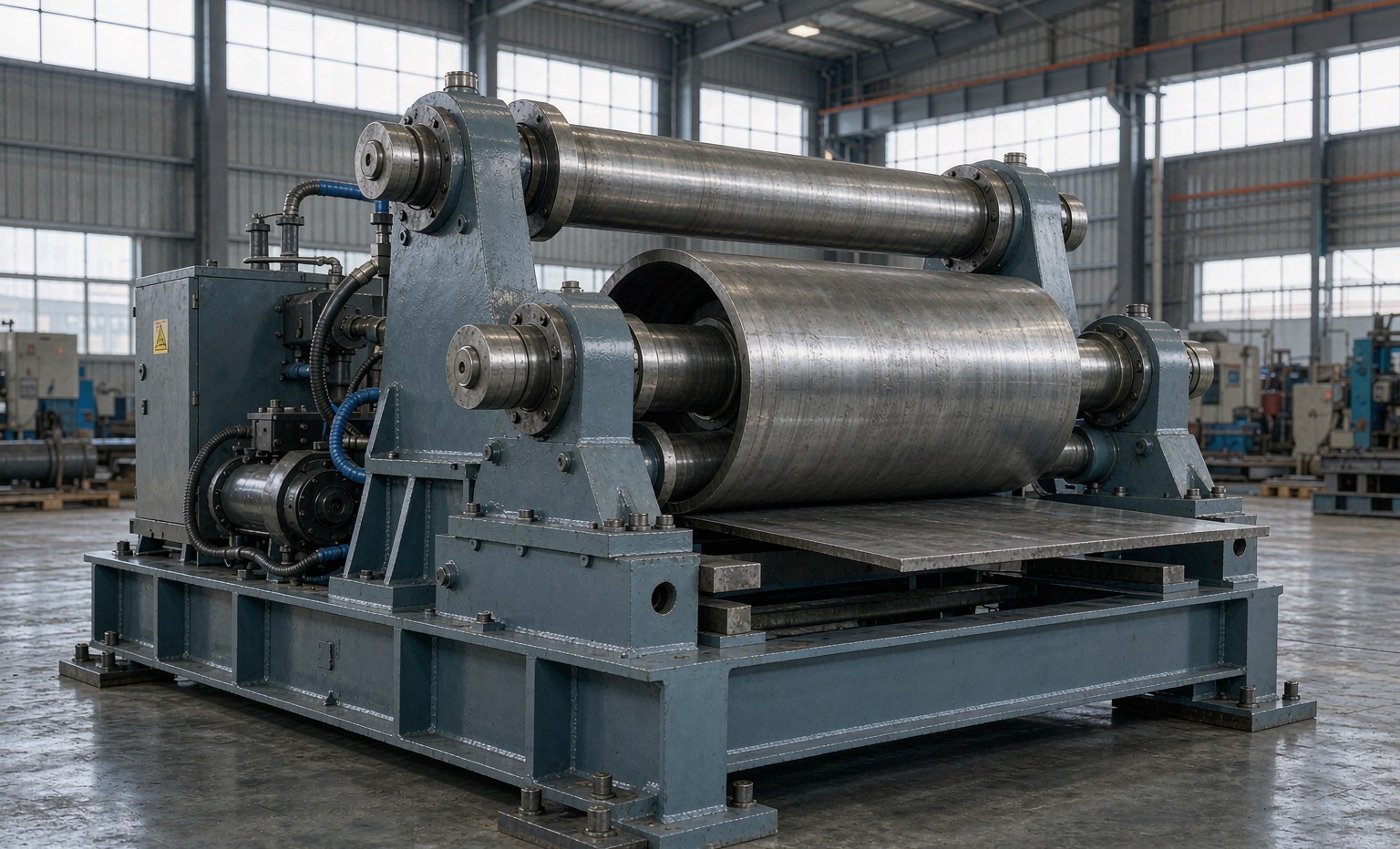
The first is the remaining straight edge. On a pyramid three-roll, any part of the plate that has not yet passed under the top roll stays flat. That flat end has to be pre-bent separately, trimmed off, or accepted as a seam step that the welder grinds out. On a four-roll machine the side rolls work close to the nip, so the curved zone starts within roughly one plate thickness of the edge and the flat left at each end falls to about 1.5 to 2 times the plate thickness.
The second is handling. A three-roll machine pre-bends one end, then the plate has to come out, turn over, and go back in for the other end. On a 2500 mm, 20 mm plate that is a crane lift, two operators and a setup check. On repeat cylinders the four-roll is typically 40 to 60 percent faster, and the gap grows with plate weight.
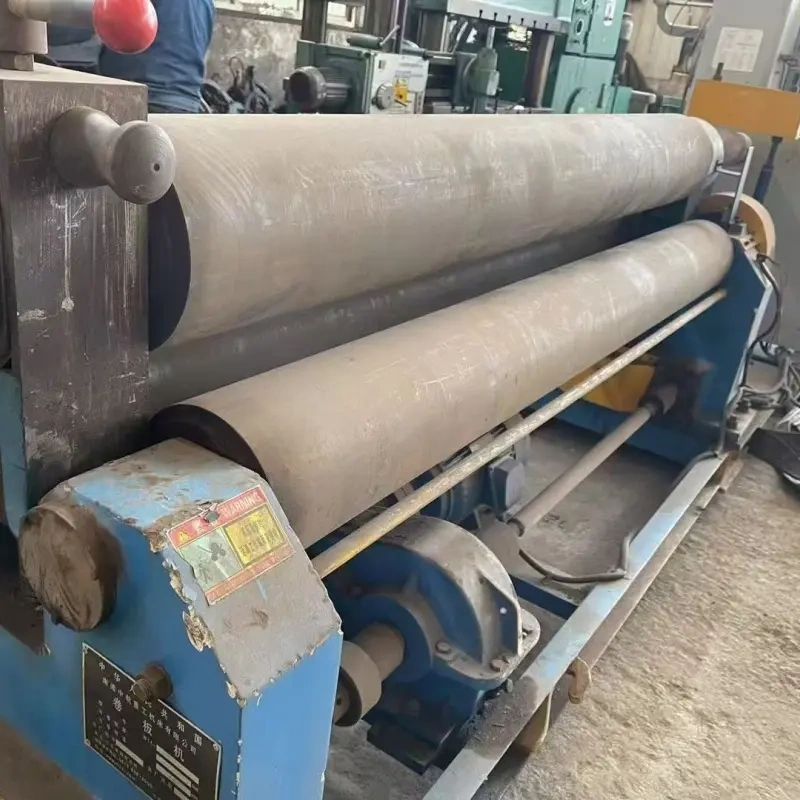
Neither number is decisive on its own. A shop that rolls three shells a week and has an experienced operator can live with a three-roll and save the capital. A shop that rolls thirty can usually justify the four-roll on crane time alone.
What Did the Customer in This Purchase Case Actually Need?
He arrived asking for a 30 × 3000 machine because a competitor had quoted one. His real work was 12 mm plate, 2400 mm wide, in 304 stainless. [Zora will replace]
He needed a 20 mm class four-roll, not the 30 mm machine he asked for. Right-sizing cut his capital outlay and still left margin for the stainless work he actually runs. [Zora will replace]
His Real Mix Was Not the Mix on the Quote Sheet
The first thing I ask for is not a specification. It is the last twenty jobs. Material, thickness, width, finished diameter, quantity. Twenty rows of real production tell you more than a wish list, because buyers tend to describe the job they hope to win rather than the work that pays the wages.
His twenty rows looked like this. Twelve jobs in 304 between 8 and 12 mm, all 2000 to 2400 mm wide, shells between 900 and 1500 mm diameter. Five jobs in Q345 at 14 to 16 mm, 2500 mm wide, mostly large ducts. Three jobs in mild steel at 6 mm for guards and covers. Nothing above 16 mm. Nothing wider than 2500 mm.
A 30 × 3000 machine would have rolled all of it without breaking a sweat. It would also have cost him a larger foundation, a heavier crane lift at unloading, more floor space, and a higher electrical connection. And on the 6 mm guard work, a heavy machine with large rolls is often clumsier than a lighter one, because the roll geometry is built for thick plate.
Where the 3-Roll Would Have Cost Him Money
The stainless mix decided the layout. Twelve of his twenty jobs were 304 shells with a visible longitudinal weld, and his welders were already grinding seam steps on the old machine. A three-roll pyramid would have kept that problem and added a crane flip on every shell.
The numbers were not dramatic, but they were consistent. Two extra handling steps per shell, roughly twelve minutes each on his sizes, across twelve stainless jobs a month. That is close to five hours of crane and operator time before a single arc is struck. The four-roll removed the flip and cut the flat end to about 1.5 to 2 times plate thickness, which is a seam his welders can close without a grinding pass.
We also checked the minimum diameter against his smallest shell. At 900 mm inside diameter, with a top roll in the 340 to 400 mm range, the geometry was comfortable. Had he needed 500 mm shells at 12 mm stainless, the answer would have changed, and I would have gone looking for a machine with a smaller top roll rather than a larger one.
What We Put in the Quotation
A capacity conversation is only useful if it ends up on paper. Our quotation for this machine listed the rolling thickness, the pre-bend thickness, the full working width, the minimum rolling diameter, the top roll diameter, main motor power, rolling speed, and the control arrangement. It also listed the accessories that quietly decide whether a machine earns its keep.
Cone rolling device, because hoppers were on his three-year plan. Side supports for thin plate, because 6 mm guards on a 2500 mm bed will sag without them. A set of spare roll bearings. Manuals and the electrical schematic. A test plate rolled at his thickness and width before shipment, filmed, with the finished diameter measured on camera. That last item is worth more than any brochure number, and it is the reason our Saudi customer Gulf Industrial Equipment LLC keeps coming back for repeat orders.
| Point | 3-roll pyramid | 3-roll asymmetric | 4-roll |
|---|---|---|---|
| Pre-bend both ends in one loading | No, plate must be flipped | One end per pass | Yes |
| Flat left at each end | Long, needs trimming or press-brake pre-bend | Medium, one end better than the other | About 1.5 to 2 times plate thickness |
| Cycle time on repeat cylinders | Baseline | About 20 to 30 percent faster than pyramid | 40 to 60 percent faster |
| Minimum diameter | Set by top roll, 1.1 to 1.5 times roll diameter | Similar, slightly better on tight work | Similar, best control at the seam |
| Operator skill needed | High, alignment after flip decides roundness | Medium | Lower, clamped feed and repeatable settings |
| CNC repeatability | Limited | Limited | Good, side rolls position independently |
| Typical used price position | Lowest | Middle | Highest |
The Price Conversation, Honestly
Two machines with the same nameplate can sit far apart in price, and the gap is usually about more than condition. Roll diameter, frame mass, hydraulic layout, control grade, and the accessories in the crate all move the number.
For reference, new Chinese W11-20 × 2500 three-roll machines appear in public listings anywhere from about USD 6,000 to USD 25,000 depending on drive type, motor brand and control package. A new heavy CNC four-roll around 3000 mm by 50 mm starts near USD 80,000. Used four-roll machines in the 20 to 30 mm class commonly trade in the tens of thousands of euros in Europe, with year and condition doing most of the work.
That spread is why I tell buyers to price the whole installation, not the machine. Freight, rigging, foundation, electrical connection, fresh hydraulic oil, and a first set of seals can add a meaningful percentage to the invoice. A cheap machine that needs a control retrofit and a hydraulic rebuild is not cheap. Our used plate rolling machine inventory page lists the machines we currently hold, and each one comes with a condition report rather than a nameplate photo.
How Do We Prove a Used Machine Still Has Its Rated Capacity?
Paper capacity and real capacity are two different machines. Before any deposit, I want to see plate go through the rolls and a gauge hold its reading.
Prove capacity under load: roll a plate at the rated thickness at full width, measure both pre-bent ends and the finished diameter, then hold hydraulic pressure for ten minutes and read the gauge.
Rolls, Crown and the Flat Spot That Gives It Away
Start with the rolls, because they carry every load the machine will ever see. Run a straightedge along each roll at several points and shine a light behind it. A roll that has been overloaded shows a belly in the middle or a wear flat where plate has been pinched in the same spot for years. Measure the diameter at both ends and in the centre. A difference of a few tenths of a millimetre across the length is normal wear. A visible step or a scored band is not, because that mark prints itself onto every shell you roll.
Crowning matters here. Rolls are ground with a slight crown so they deflect into a straight line under load. A roll that has been reground flat, or reground badly, will roll a barrel-shaped shell at high load and a straight one at low load. Ask whether the rolls have ever been reground, and ask for the crown specification if the answer is yes.
Parallelism is the next gate. With the rolls clean and separated, measure the gap at both ends and in the middle. A laser alignment tool is ideal, but a straightedge, feeler gauge and dial indicator will find a real problem. Our shop gate is around 0.05 mm end to end on a machine of this size. Beyond that, the shell comes out tapered or lobed and no amount of operator skill fixes it.
Hydraulic Hold, Oil and the Ten-Minute Test
Hydraulics are where a tired machine hides. Bring the top roll down to a working position, note the gauge, and leave it for ten minutes with the pump off. A drop of more than about 0.5 MPa in that window points to internal leakage past a cylinder seal or a directional valve. That is not a fatal fault, but it is a repair, and it belongs in the price.
Look at the oil colour through the sight glass. Milky oil means water has got in, usually from a wash-down hose or condensation in a humid yard. Dark oil means it has been running hot. Either way, plan on a full drain, a flush and a filter change before the machine goes into production. Pull the breather and smell the oil. A burnt smell is a pump that has been working beyond its relief setting.
Then put plate through it. Roll a sample at the rated thickness, at full width if you can get the plate, and measure the result. Check the diameter at both ends and in the middle, check the gap at the seam, and check that both pre-bent ends match. A machine that rolls a good sample at 70 percent of rating but groans at full rating has told you something important.
The Paper Trail That Protects the Buyer
Documentation is part of capacity. Ask for the manual, the hydraulic schematic, the electrical drawing, and any maintenance record. Ask what material and thickness the previous owner ran most often, and why the machine is being sold. A machine that spent ten years at 95 percent of rating will show it in the rolls and the frame welds, even if it looks clean after a repaint.
Check the frame for welded repairs around the side housings and the drop-end mechanism. A crack that has been stitched and ground smooth is a question about overload history, not a cosmetic issue. Test every emergency stop, every guard interlock and the foot switch, and confirm the machine stops the way the manual says it should. The relevant references are ISO 12100 for risk assessment, ISO 14120 for guards, IEC 60204-1 for the electrical system, and OSHA 1910.212 for point-of-operation guarding in the United States.
| Inspection gate | Accept | Investigate | Reject or reprice heavily |
|---|---|---|---|
| Roll surface | Smooth, even polish, no steps | Light scoring, minor wear bands | Deep gouges, flat spots, visible bend |
| Roll diameter across length | Within a few tenths of a mm | 0.3 to 0.5 mm taper | Over 0.5 mm or a measurable step |
| Roll parallelism | About 0.05 mm end to end | 0.05 to 0.1 mm | Over 0.1 mm, shell comes out lobed |
| Hydraulic pressure hold, 10 minutes | Drop under 0.2 MPa | 0.2 to 0.5 MPa | Over 0.5 MPa, internal leak |
| Hydraulic oil | Clear amber | Slight darkening | Milky or burnt, plan a full service |
| Frame and housings | Original welds, no repairs | Minor cosmetic weld | Cracks or structural repairs |
| Test roll at rated thickness | Diameter and seam within spec | Slight ovality at full width | Stalls, slips, or will not close the seam |
| Safety devices | All E-stops and interlocks trip | One lazy limit switch | Guards missing or bypassed |
Conclusion
Capacity is a calculation, not a nameplate. Size from the worst job, add margin, verify under load. That is how a used plate roll pays for itself.