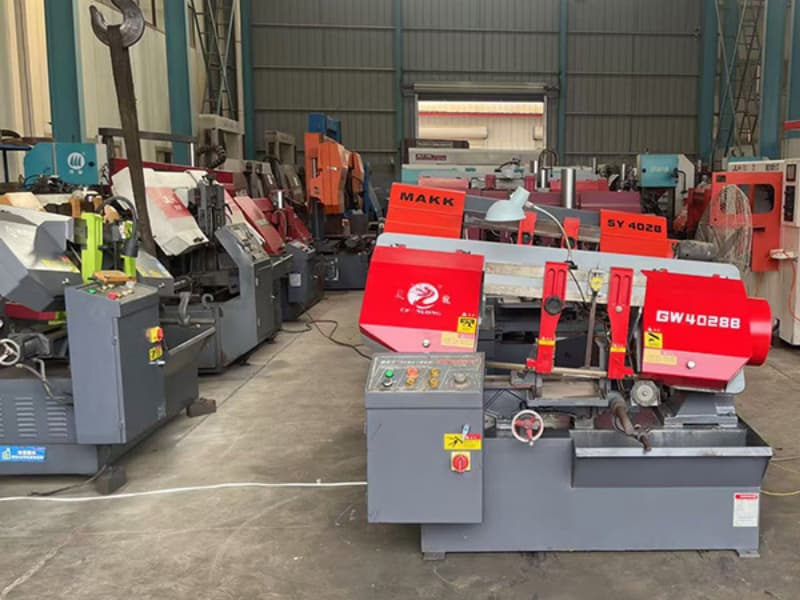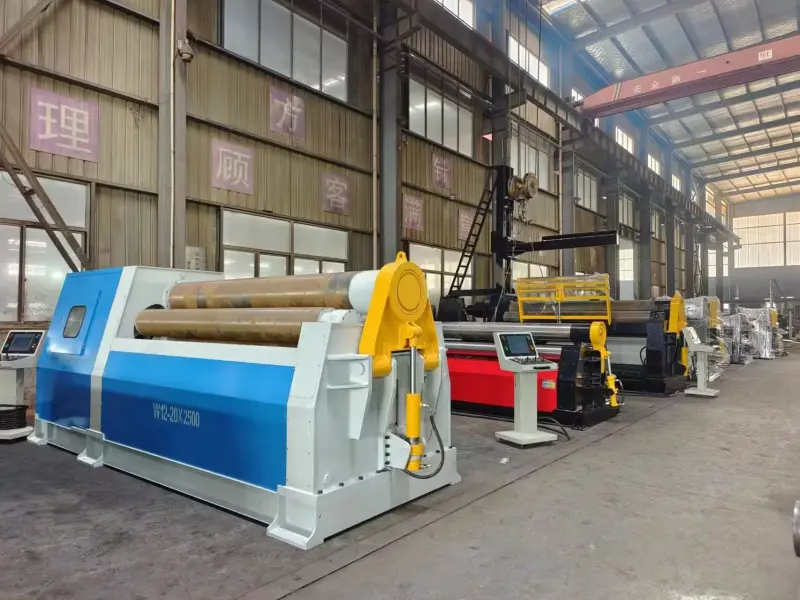


Most buyers who call us about a used guillotine shearing machine have already lost time on quotes that look good on paper. The wrong machine burns money twice — first in freight, then in scrap and downtime — so we walked this customer through every check before he paid.
A used guillotine shearing machine is the right choice when your work is straight cutting of plate at 4 to 16 mm thickness, and the machine passes five checks: blade condition, blade gap adjustment, hold-downs, hydraulics, and a measured test cut. We helped a Saudi buyer pick one in under three weeks by running exactly that sequence.
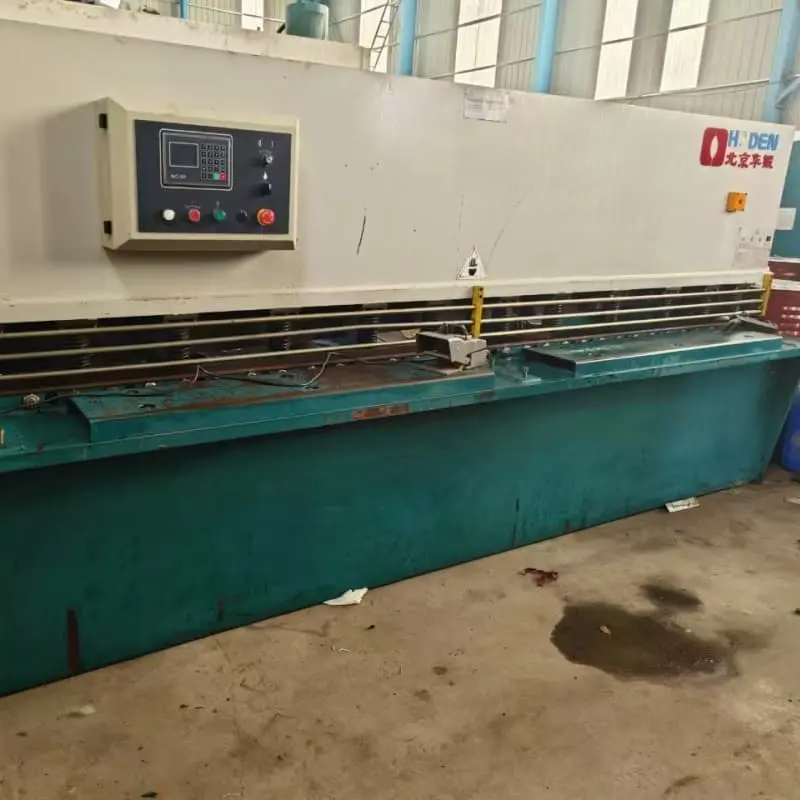
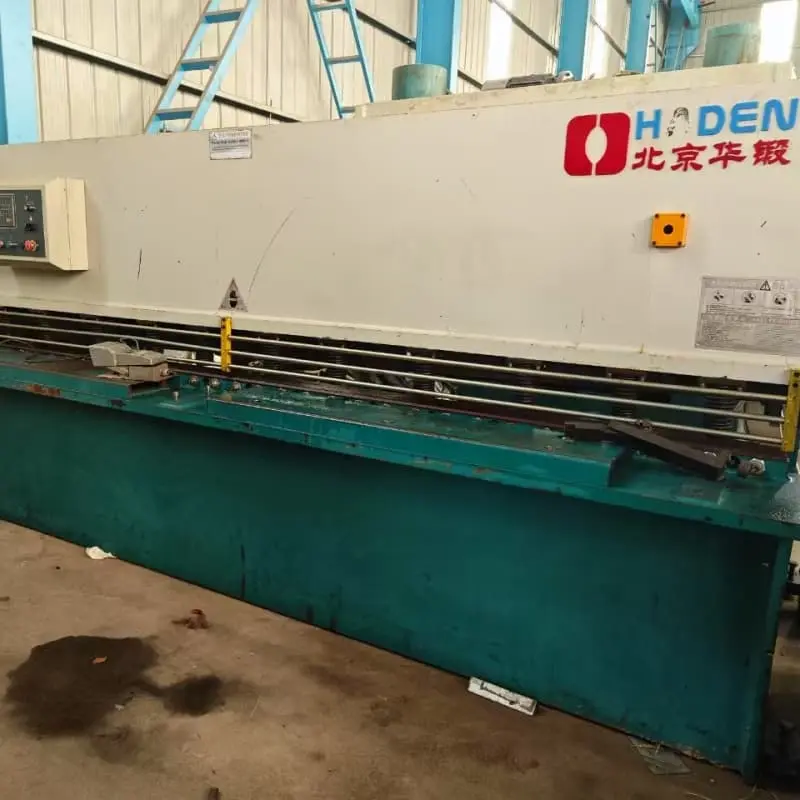
The customer came to us through a referral from an equipment distributor he had worked with before. He runs a steel fabrication shop that feeds structural and enclosure work to contractors near Dammam, and his old mechanical shear had become the bottleneck of the whole line. What he wanted was simple to state and hard to buy blindly: a hydraulic guillotine shear that cuts 3,200 mm long plates up to 12 mm thick, holds tolerance on repeat cuts, and does not need a full rebuild within a year. He also had a scar. A previous supplier had shipped him a machine that looked nothing like the photos, so this time he demanded real photos, a running video, and third-party inspection before payment. That demand matched exactly how we already work, and it set the structure for the whole project.
Why Did This Buyer Need a Guillotine Shear Instead of a Swing Beam Machine?
His shop cuts long blanks of carbon steel plate all day, and the edges feed straight into bending and welding. A machine that twists narrow strips or burrs every edge would push that work straight back into grinding, so the drive type had to be settled first.
For 12 mm carbon steel at 3,200 mm length, a hydraulic guillotine shear is the better pick: the vertical blade beam gives higher rigidity, the adjustable shear angle reduces distortion on thick plate, and the four-edge blades keep cut quality stable through long production runs. Swing beam machines stay a good option only for thinner, faster work.
Cutting Length and Thickness Set the Frame
We started where every shear selection should start: with the parts, not the machine. The customer measured a week of real production for us. Most blanks were 2,000 to 3,100 mm long, and the heaviest material was 12 mm Q235-equivalent carbon steel. From that we set three hard numbers: cutting length of at least 3,200 mm, rated thickness of at least 12 mm on mild steel, and a backgauge travel that covers his most common blank width of 600 mm.
One detail mattered more than the rest. A shear rated at 12 mm cuts that thickness only when the material tensile strength stays near 450 N/mm². His plate fits that window, but he also cuts some higher-strength plate, so we advised him to treat 12 mm as the ceiling for normal work and 10 mm as the practical working maximum for the harder grades. This is the kind of math that never appears in a listing title, and it is where a listing like “12 mm shear” quietly becomes an 8 mm machine in real production.
Hydraulic Guillotine vs Swing Beam vs Mechanical Drive
The drive type decides how the machine behaves for the next ten years, so we put the three options side by side before talking price.
| Aspect | Hydraulic guillotine | Swing beam (hydraulic) | Mechanical (flywheel) |
|---|---|---|---|
| Blade motion | Vertical straight down | Arc on a pivot beam | Straight, clutch-driven |
| Rigidity at full width | High — beam guided in side frames | Medium — pivot wear shifts the gap | High but aging clutch risk |
| Thick plate (10–16 mm) | Best fit | Marginal | Possible, if clutch is sound |
| Thin sheet speed | Moderate (16–45 strokes/min) | Faster cycling | Fastest |
| Shear angle adjustment | Usually adjustable 0.5–1.5° | Fixed by beam design | Fixed |
| Blade design | Four usable edges, easy gap setting | Two long blades, less edge reserve | Four edges, older geometry |
| Control retrofit | Easy — NC/CNC backgauge retrofits well | Possible but less common | Rare and costly |
| Best use | Thick plate, repeat accuracy, blanks for bending | Thin sheet, high volume, lighter budget | Simple repetitive cutting, older shops |
The customer’s mix of long, thick plate and repeat blanks sat squarely in the guillotine column. He also liked that a guillotine frame tolerates a controller upgrade later; a swing beam machine with worn pivot links cannot be corrected by any retrofit, because the play sits in the mechanical guidance itself. I have seen buyers save 15 percent buying a swing beam machine for thick-plate work, then lose that saving in one quarter of regrinding and straightening. In my own view, that trade is almost never worth it above 8 mm.
The Blade Gap and Rake Angle Numbers That Matter
With the drive type settled, we taught the customer the two settings that decide cut quality on any used shear. The first is blade clearance. For mild steel, a workable reference is 5 to 10 percent of sheet thickness — around 0.3 to 0.6 mm on a 6 mm plate. Too large a gap produces burrs and rolled edges; too small a gap drives cutting force and blade wear up sharply. On a used machine the question is not only what the gap is set to now, but whether the adjustment still moves cleanly and holds its position along the full cutting length.
The second is rake angle, the inclination of the upper blade, which on hydraulic guillotine machines sits between roughly 0.5 and 2.5 degrees. A steeper angle lowers cutting force on thick plate but twists narrow strips; a shallower angle cuts thin sheet with less distortion. Because his blank widths vary, adjustable rake was worth having. We also flagged a third, quieter issue: blade edge reserve. Four-edge blades give four working lives before regrinding, and regrinding itself is only possible until the blade runs out of section or develops cracks. A blade set that needs full replacement soon is a hidden cost on the order of [Zora will replace] — our own supply price for a 3,200 mm set sits well below European market levels, but it must be counted either way.
How Did We Inspect the Machine Before the Customer Paid?
Photos can hide almost everything on a shear, because the working parts sit low and dark inside the frame. So the inspection was structured, filmed, and sent to the customer segment by segment before he committed.
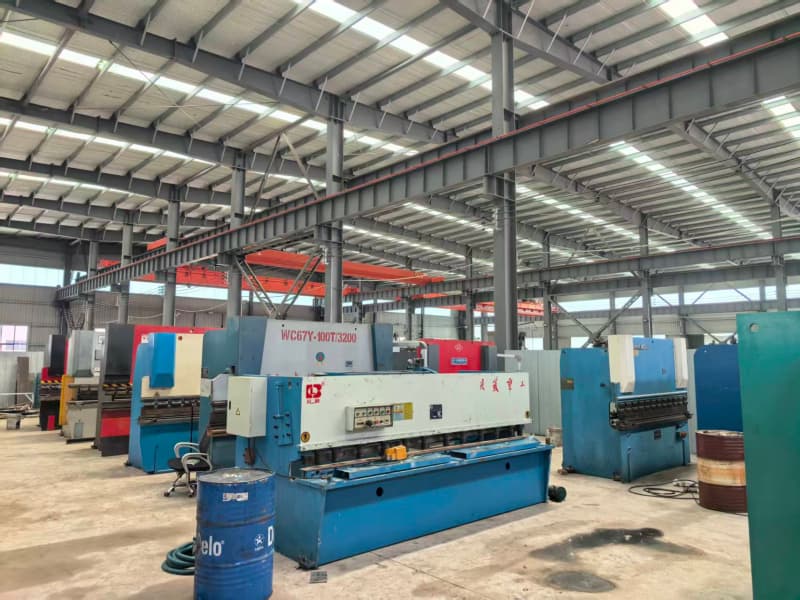
We inspected the machine in four passes — blades and hold-downs, hydraulics and electrics, backgauge repeatability, and a measured test cut at left, middle and right of the blade. Every pass was filmed with the machine running, so the buyer saw exactly what we saw before any money moved.
Blades, Hold-Downs and the Table
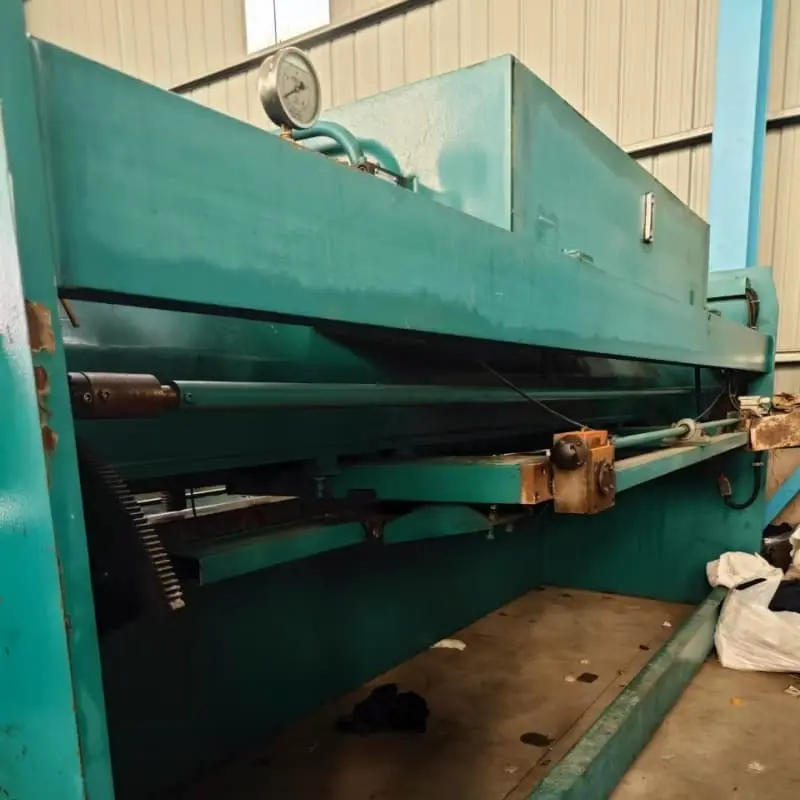
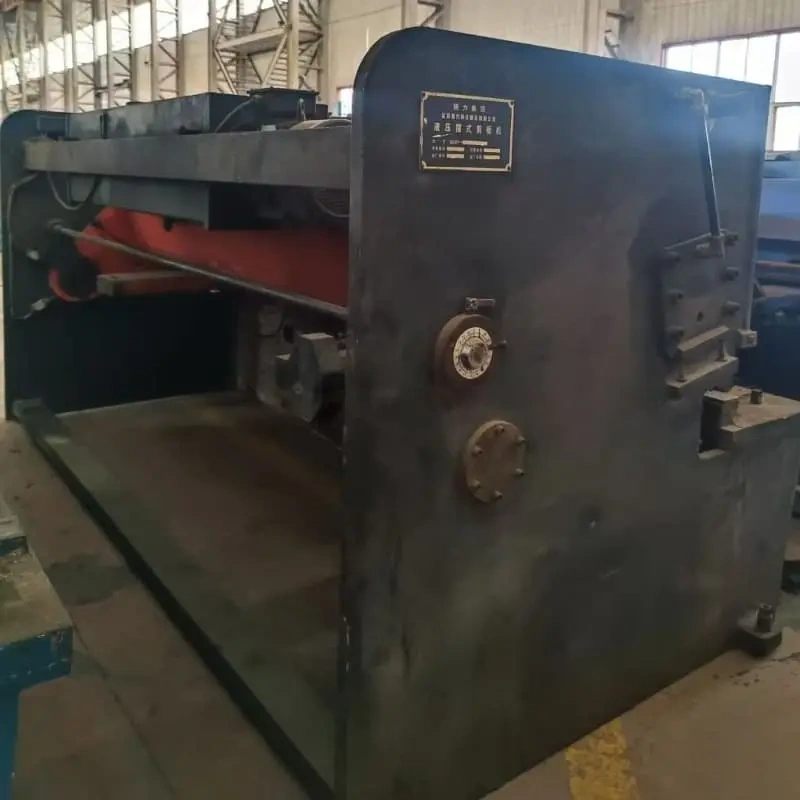
We started with the cutting line itself. Both blades came off their seats for a visual check: no cracks, no chipping, edge wear consistent along the length, and enough section left for at least one regrind per edge. Blade seating matters as much as edge condition — a blade seated on a scored or deformed holder can never close the gap evenly, so we checked the lower blade holder and table surface for scoring and pitting as well.
Then the hold-downs. We cycled every clamp across the full 3,200 mm and watched for even, firm clamping. A single weak hold-down lets the sheet lift during the cut, and the result is a slanted edge and a dimension that drifts. On this machine all hold-downs responded together, which told us the clamping circuit had been kept healthy. I always do this check by hand first, before any hydraulic test, because fingers find what gauges miss — uneven clamp timing shows up as a soft spot you can feel under the sheet.
Hydraulics and the Electrical Cabinet
The hydraulic system is where most used shears hide their real age. We checked oil level, color and smell — dark or milky oil means water ingress or long-overdue changes — then ran the machine and watched system pressure at idle and under load on the gauges. The cylinders showed no scoring or rod leaks, and the ram stroke stayed smooth with no lag or drift at the bottom of the cut. Hoses, fittings and the relief valve were all inspected, and the filter condition was noted for the maintenance plan we hand over with every machine.
The electrical cabinet told a good story: clean wiring, no overheating marks, original controller present, and all limit switches, emergency stops and interlocks responding. The controller on this class of machine is commonly an E21S, DAC310T or ELGO P40 type, and parts for all three remain easy to source. Obsolete or replaced controllers are a red flag we take seriously, because a failed proprietary board can strand a machine as completely as a broken cylinder.
The Test Cut Tells the Truth
Everything before this point is preparation; the test cut is the verdict. We sheared sample plate at 10 mm and 12 mm across three positions — left end, middle, right end of the blade — and measured each piece for squareness, burr height and twist. The backgauge then ran ten repeat moves to the same position to test repeatability against its nominal ±0.05 mm class.
| Check | Method | Result on this machine | Pass threshold we use |
|---|---|---|---|
| Edge squareness | Bevel protractor / square at 3 positions | Within 0.5° across width | Under 1° |
| Burr height | Visual + fingernail, feeler on thick cuts | Fine, uniform burr | Uniform, no tearing |
| Blank length drift | Caliper, 5 blanks at same gauge setting | Within ±0.3 mm | Within ±0.5 mm |
| Backgauge repeatability | Dial indicator, 10 cycles | Return within 0.05 mm | Within 0.1 mm |
| Twist on narrow strips | Straightedge on 100 mm strip | None visible | Minimal |
| Stroke behavior | Watched full cycle ×20 | Smooth, no drift or jolt | No drift, no jolt |
One number deserves its own sentence: the blank length stayed inside ±0.3 mm across five consecutive cuts, which is better than we usually see on machines of this age. That single measurement did more to close the deal than any photograph could. For buyers who cannot stand in our shop, this is the reason our inspection videos always include the measuring step — how we test a used shearing machine before delivery is a process we can show, not just claim.
What Did the Numbers Say About Price, Logistics and Total Cost?
With the machine technically confirmed, the conversation turned to money — purchase price, freight to Dammam, and what the machine would cost to keep cutting for five years.
A used QC11Y-class hydraulic guillotine shear of this size trades between roughly 5,000 and 20,000 US dollars depending on capacity and condition — about 40 to 70 percent below new. Add blades, freight, packing and import duties, and the delivered cost still lands far under a new machine with comparable cutting capacity.
Where Used Guillotine Shears Actually Price Out
We showed the customer the real market spread so he could judge our quote against it. Machines in the used Chinese market cluster like this:
| Machine class | Typical used price (USD) | New equivalent (USD) | Notes |
|---|---|---|---|
| 4×1600 manual/small shear | 1,200–2,500 | 4,000–6,000 | Light workshop work |
| QC12Y-8×3200 swing beam | 6,500–7,500 | 13,000–18,000 | Thin-to-medium sheet |
| QC11Y-8×2500 CNC guillotine | 9,000–10,500 | 20,000–28,000 | E21S/DAC310T class |
| QC11Y-16×3200 guillotine | 5,700–11,000 | 28,000–40,000 | 12,800 kg frame class |
| QC12Y-20×3200 swing beam | ~20,000 | 35,000–55,000 | Heavy swing beam |
| CNC guillotine 12×4000 class | 15,000–25,000 | 35,000–55,000 | Full CNC backgauge |
Two lessons sit in that table. First, a guillotine frame in the 16×3200 class can be bought used for a fraction of its new price, and the gap between our quote and the cheapest listing usually reflects blades, hydraulics and inspection depth — not margin. Second, the listed price is never the landed price. The buyer’s own calculation added sea freight and wooden-case export packing, Saudi import duty and VAT, and rigging at destination. Even with all of that, his total landed cost came in near half of a new equivalent — and the machine was in stock, so it could ship in weeks instead of a production lead time of many months. That availability gap is the quiet argument for used equipment that price tables never show.
Packing, Shipping and Import Notes
Export logistics on a 12-ton-class shear are routine for us but unfamiliar to many first-time buyers, so we walked him through each step. The machine ships in a fumigated wooden case with anti-rust protection on the blade line and machined surfaces, consistent with standard pre-shipment practices. Third-party inspection — in his case SGS before shipment — verifies the machine against the report we already issued, so nothing at the port depends on trust alone. Documentation for customs clearance goes with the shipment, and delivery lands at Dammam Port on the schedule his freight forwarder confirms.
For buyers in other markets the details change — voltage, duty rates, port of entry — but the structure does not: confirmed machine, filmed inspection, third-party verification, export-grade packing, complete paperwork. Our used shearing machines currently in stock all go through this same route, which is why repeat customers rarely negotiate the process twice.
The Decision the Customer Made
The customer shortlisted two machines: this QC11Y-class 12 mm machine and a lighter 8×3200 swing beam unit priced about 30 percent lower. The swing beam lost on capacity math — his 12 mm plate sat at that machine’s absolute ceiling with no reserve, while the guillotine cut his ceiling grade at 10 mm with margin, held better squareness on narrow strips, and carried four-edge blades. He placed the order after reviewing the full video set and the SGS report, and the machine shipped in a wooden case with spare seal kits and a documented maintenance schedule.
His feedback afterward matched what we hear from most of the buyers we serve this way: the machine matched the videos and report exactly, communication stayed fast through the whole cycle, and the packing arrived intact. That is the outcome we aim for on every used guillotine shearing machine we sell — the inspection sequence decides it, and the sequence never changes: frame and blades first, hydraulics and electrics second, measured test cut third, then price.
Conclusion
Choosing a used guillotine shearing machine comes down to capacity math, blade and hold-down condition, hydraulic health, and one honest measured test cut. Run that sequence — or buy from someone who films it — and the used market pays you back generously.