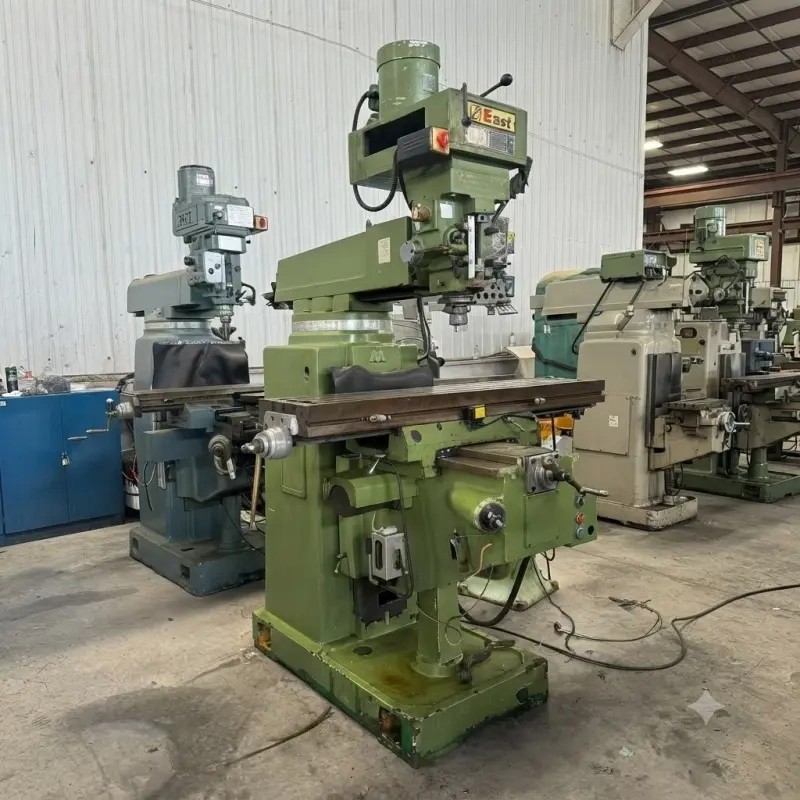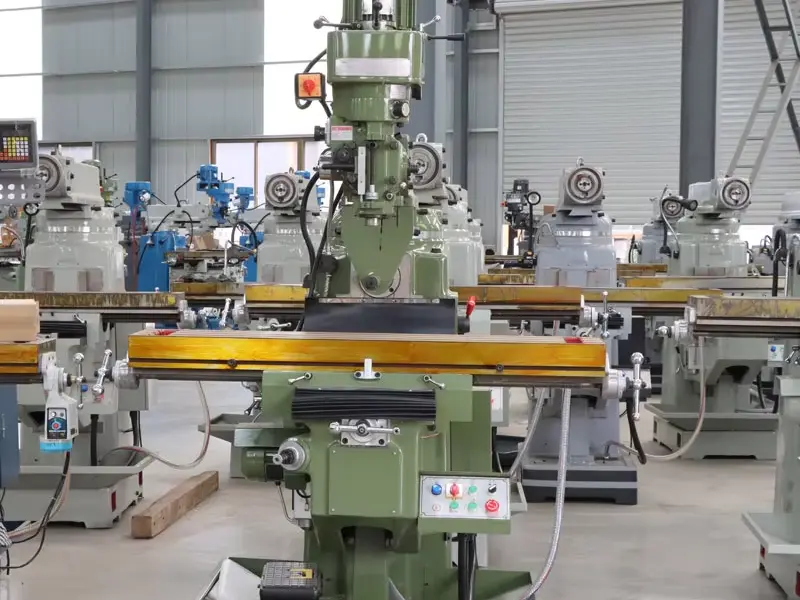


A used mill with a worn swivel head or a 50 Hz motor is an expensive mistake. Here is how we proved this X6230 before it shipped to Dammam.
A used X6230 universal milling machine suits a Saudi job shop because it mills horizontally and vertically on one 300 × 1270 mm table, weighs about 1,800 kg, and costs roughly $3,000–$4,500 used against $21,000 or more new. The catch is geometry, swivel-head wear, and the 60 Hz power difference.
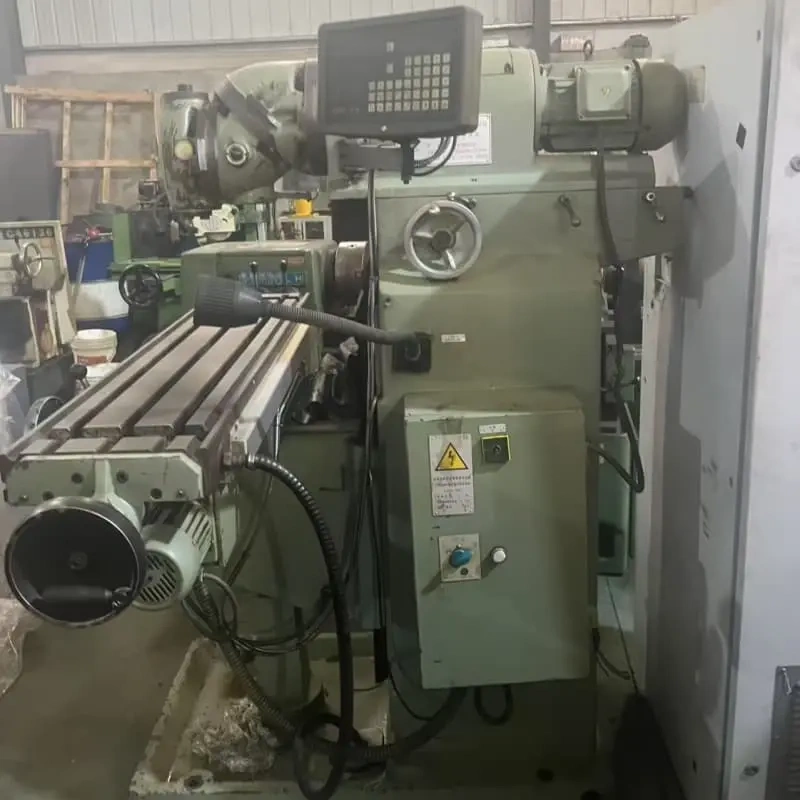
This was not a large order. One machine, one container position shared with a small surface grinder, one buyer in the Eastern Province who had already been let down twice by suppliers who sent photos of a different machine than the one that arrived. What made the deal interesting was not the price. It was the list of things he wanted proven before he released the balance payment, and the fact that a universal mill has more moving joints than a plain vertical mill, so there is more to prove.
What Makes a Universal Milling Machine Worth More Than a Vertical Mill to a Saudi Job Shop?
Most Saudi job shops do not need another vertical mill. They need one machine that cuts keyways, gear teeth and angled faces without a second setup.
A universal mill adds a swivelling table and a rotating head to the horizontal spindle, so one machine handles horizontal arbor work, vertical face milling, angular cuts and, with a dividing head, helical flutes. That flexibility is why job shops still buy them.
What the X6230 Adds Over a Plain Horizontal Mill
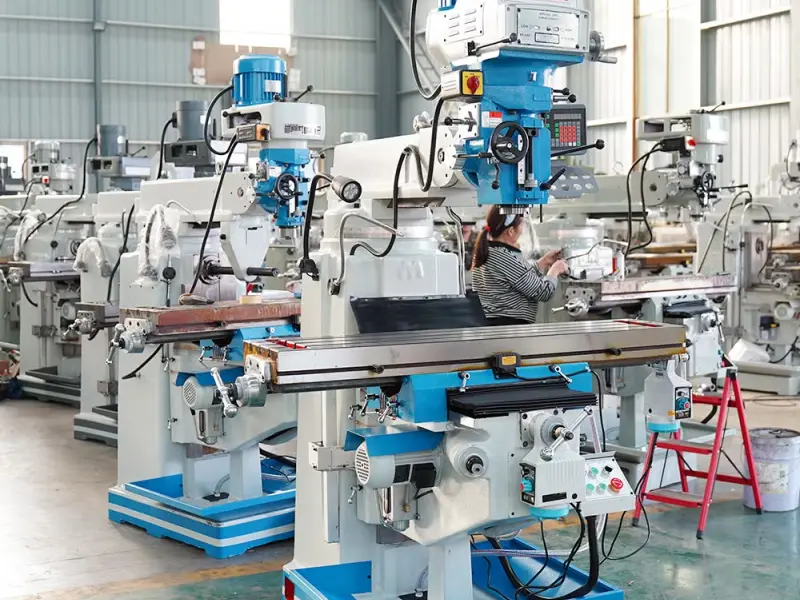
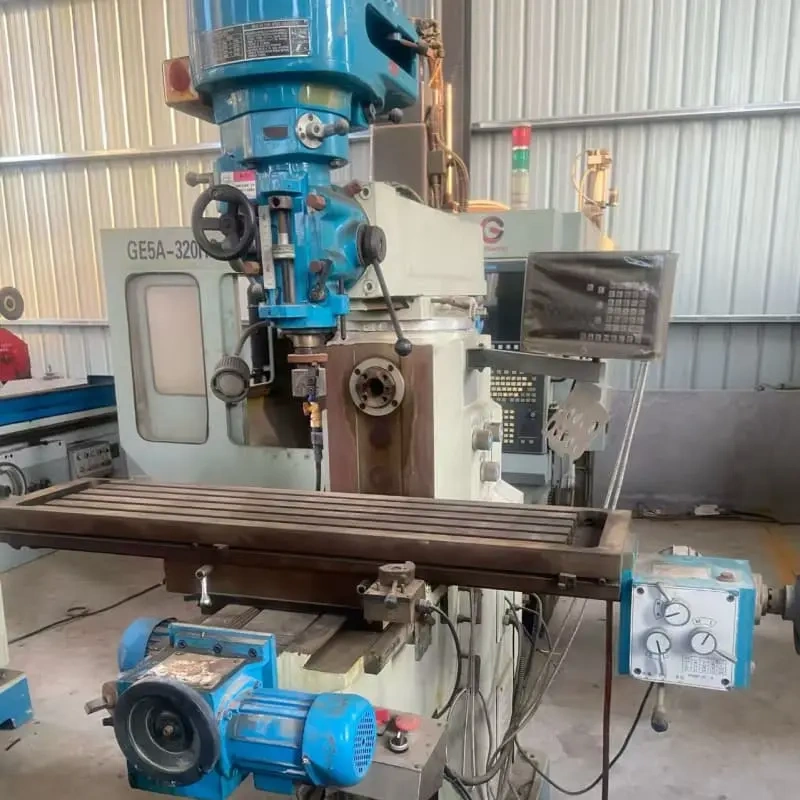
The X6230 is a knee-type universal mill. The column carries a horizontal spindle at the top, an overarm slides out over the table, and an arbor support drops onto the far end of the cutter arbor. That is standard horizontal practice, and it is still the most rigid way to run a wide slab cutter or a gang of cutters in a single pass.
What makes the machine universal is the second layer. The table sits on a graduated swivel base that turns plus or minus 45 degrees about a vertical axis, and the milling head itself rotates a full 360 degrees. Swing the head down and you have a vertical spindle for face milling, pocketing and drilling. Swing it to an angle and you can machine a bevel or a compound angle without re-clamping the part. Swivel the table and couple the table lead screw to a dividing head through change gears, and the work rotates as the table feeds. That is how a helix gets cut on a machine with no electronic control at all.
In a Saudi job shop this matters more than the catalogue numbers suggest. The work that keeps these shops alive is repair and replacement: a pump bracket with a worn face, a conveyor shaft that needs a new keyway, a gear that has to be duplicated because the original came from Italy and the replacement takes fourteen weeks. A vertical mill can face and slot. It struggles to cut a helix, and it cannot run a 100 mm slab cutter on an arbor with outboard support. The X6230 does both, on one foundation, with one operator.
[Zora will replace] The buyer in this case runs a maintenance and fabrication workshop in Dammam with nine employees, and about 60 percent of his milling work is one-off repair rather than batch production. That ratio is the whole argument for a universal machine. A shop doing 5,000 identical brackets a month should buy a CNC. A shop doing forty different repair jobs a month should buy flexibility, and flexibility on a manual mill means a swivel table and a rotating head.
The Four Table Lengths That Decide the Price
X6230 is a family, not a single specification. The same basic casting is sold with four table and travel combinations, and the difference in usable length is what separates a $2,900 machine from a $4,300 machine on the used market.
| Model | Table (mm) | X travel | Y / Z travel | Spindle | Main motor | Weight |
|---|---|---|---|---|---|---|
| X6230 | 1270 × 300 | 720 mm | 300 / 400 mm | 45–1660 rpm, 11 steps, ISO40 | 3 kW | 1800 kg |
| X6230A | 1370 × 300 | 820 mm | 300 / 400 mm | 45–1660 rpm, 11 steps, ISO40 | 3 kW | 1850 kg |
| X6230B | 1270 × 300 | 900 mm | 300 / 400 mm | 45–1660 rpm, 11 steps, ISO40 | 3 kW | 1850 kg |
| X6230C | 1370 × 300 | 1000 mm | 300 / 400 mm | 45–1660 rpm, 11 steps, ISO40 | 3 kW | 1900 kg |
| Heavy build | 320 × 1320 | 700–820 mm | 280–340 / 300–340 mm | 30–1500 rpm, 18 steps, ISO40 | 7.5 kW | 2850–2950 kg |
Two things in that table catch buyers out. First, the table size barely changes across the four standard variants while the travel changes by 280 mm, so a listing that says “1270 × 300 table” tells you nothing about how much length you actually get. Second, there is a heavier 7.5 kW build sold under the same model name. It weighs a tonne more, cuts three times harder at low speed, and costs more to ship. If a quotation looks unusually cheap for an X6230, check the motor rating and the weight before you check anything else.
Where These Machines Actually Earn Money in the Kingdom
Saudi Arabia’s metal fabrication market is not one market. It is a small number of large integrated fabricators serving giga-projects, and a very broad base of small and mid-sized job shops serving local construction, industrial maintenance and repair. The Eastern Province, where Dammam and Jubail sit, accounts for close to 40 percent of the country’s fabrication demand because the oil, gas and petrochemical complexes are there. Welding and tubing is the single largest service segment at roughly a third of the market. Vision 2030 targets raising manufacturing’s share of GDP from about 11 percent to more than 20 percent, and that target is being chased with industrial city incentives rather than with new mega-factories alone.
The practical consequence for a used machine seller is that the buyers are not all sophisticated. Many are competent fabricators who have never owned a milling machine and are adding a machining capability to a welding business. They do not want a control they cannot program and a service contract they cannot afford. They want a geared-head mill with handwheels, a dial and a vice, and they want to be shown that it cuts straight. The skilled machinist shortage in the Kingdom, which is real and well documented, pushes the same way: a manual machine can be run by an experienced expatriate machinist on the first day, while a CNC needs a programmer, a post-processor and somebody who can recover parameters after a battery failure.
How Do You Check the Geometry of a Used X6230 Before You Pay?
Paint tells you nothing. Four measurements decide whether a used X6230 is a machine or a rebuild project, and all four take an hour with a dial indicator.
Check table flatness (0.02 mm per 1,000 mm), spindle-to-table squareness (0.02 mm per 300 mm), spindle runout at the taper (0.005 mm or less) and backlash on all three axes (0.02 mm or less). Add a swivel-head repeatability test, because that joint is the X6230’s weak point.
Start With the Table, Not the Spindle
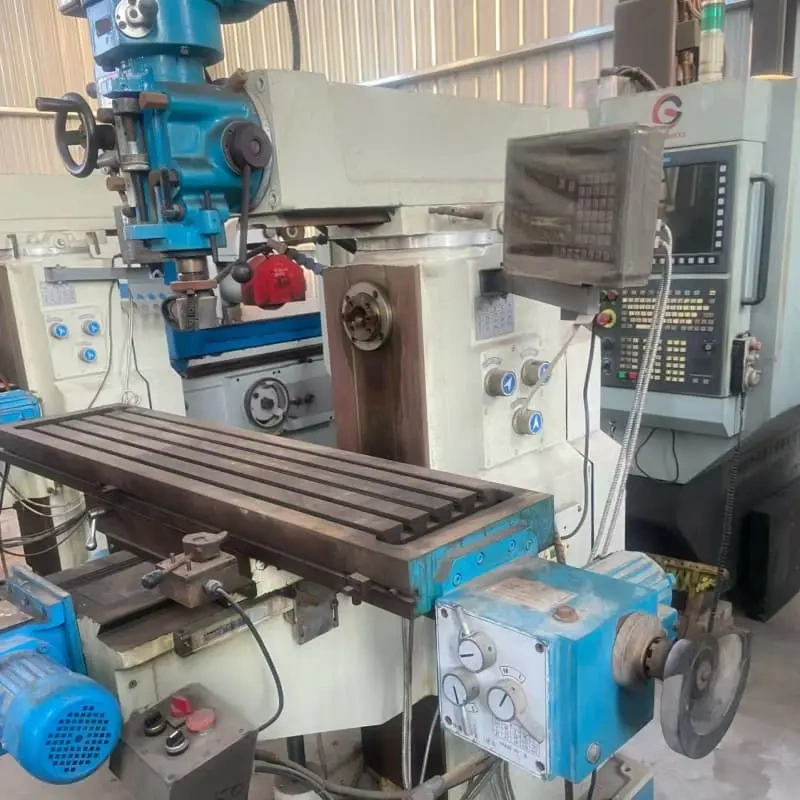
Everybody wants to indicate the spindle first because it is the expensive part. I always start with the table, because a table that has been abused tells you how the whole machine was treated. Put a precision straightedge across the table at three positions along its length and sweep underneath with a 0.01 mm indicator, or sweep the bare table surface with a dial indicator on a magnetic base riding a granite parallel. What you are looking for is not absolute flatness but local damage: a dip in the middle where the same fixture sat for fifteen years, or a ridge where a workpiece spun.
Acceptable deviation is around 0.02 mm over 1,000 mm on a Chinese-built knee mill of this class. A table with 0.05 mm of local relief in the working zone is not scrap, but it will show up in every flat part you clamp in the middle, and it is not something you fix with a file. Then check the T-slots with a square and a feeler gauge. Slots that have been hammered open by incorrect clamps are a sign of a machine run by people who did not care, and that is your best predictor of what the gearbox will sound like.
While the indicator is out, sweep the table surface against the spindle axis in the vertical mode. Squareness of 0.02 mm over 300 mm is the working target. Beyond 0.04 mm over 300 mm you are into shimming the column or re-scraping the knee, which is a two-week job in a workshop that has the scraping skills, and most do not.
The Swivel Head Is the Weak Point Nobody Checks
This is the check that separates a real inspection from a walk-around. A universal head rotates on a circular joint, usually a worm and segment or a hardened serrated coupling, locked by two or three bolts. Every time an operator swings that head to cut an angle and swings it back, the joint wears a little. After ten or fifteen years of daily use, the head can still rotate freely and still lock, and still be out of position by 0.05 mm over 300 mm when it comes back to zero.
The test is simple. Fit a 300 mm test bar in the spindle, set the head to zero, indicate the bar at 300 mm, and record the reading. Now swing the head away and back, lock it, and indicate again. Do it three times, and do it once from each direction so you approach zero from plus and minus. A healthy head repeats within 0.005 to 0.01 mm over 300 mm. A worn one drifts 0.03 to 0.08 mm, and no amount of care in operation will fix it, because the error is in the joint, not the operator.
On a machine that will spend its life doing horizontal work with the head parked at zero, a drifting swivel joint is a nuisance rather than a disaster. On a machine bought specifically to cut angles and helices, it is the difference between a useful purchase and a paperweight. Ask the buyer what he intends to do with the head before you decide how much that number matters.
While the head is off zero, look at the drive. On the X6230 the vertical head is driven from the main gearbox, and the change from horizontal to vertical is made by engaging a gear or a clutch. Run both modes for two minutes each at mid speed and listen. A rumble in vertical mode that disappears in horizontal mode points at the bevel pair or the vertical shaft bearings, and that is a gearbox-out repair.
Backlash, Quill Drift and the Test Cut
Backlash on a used knee mill is where most negotiations happen, and most buyers negotiate on the wrong axis. Check all three. On the X and Y screws, 0.02 mm is fine on a machine of this age, 0.02 to 0.05 mm is adjustable through the nut or the gib, and anything over 0.05 mm means a new nut or a new screw. On Z, the knee screw carries the whole table and workpiece, so wear shows up faster; 0.03 mm is acceptable and 0.08 mm is not, because the table will drop when you release the clamp.
Quill drift is the other one people skip. Retract the quill fully, indicate the spindle nose, plunge the quill 25 mm and indicate again. A drift under 0.013 mm is normal. Above 0.025 mm the quill bore or the quill itself is worn, and every drilling operation will wander.
Then cut metal. Clamp a 200 × 200 mm block of mild steel, take a light face cut in vertical mode, and measure the part for squareness and parallelism. A taper under 0.01 mm across 200 mm is a machine that will hold general work. More than 0.03 mm and you are looking at a geometry problem that will cost more than the machine is worth. Run the spindle at top speed for thirty minutes and re-check the housing temperature; more than 30 degrees Celsius above ambient means bearing preload or lubrication trouble.
| Check | Accept | Investigate | Walk away |
|---|---|---|---|
| Table flatness | ≤ 0.02 mm / 1000 mm | 0.02–0.05 mm | > 0.05 mm in working zone |
| Spindle-to-table squareness | ≤ 0.02 mm / 300 mm | 0.02–0.04 mm | > 0.04 mm / 300 mm |
| Spindle taper runout | ≤ 0.005 mm | 0.005–0.010 mm | > 0.010 mm |
| Head swivel repeatability | ≤ 0.01 mm / 300 mm | 0.01–0.03 mm | > 0.03 mm / 300 mm |
| Backlash X / Y | ≤ 0.02 mm | 0.02–0.05 mm | > 0.05 mm |
| Backlash Z (knee) | ≤ 0.03 mm | 0.03–0.08 mm | > 0.08 mm |
| Quill drift | ≤ 0.013 mm | 0.013–0.025 mm | > 0.025 mm |
| Spindle housing rise | ≤ 30 °C above ambient | 30–40 °C | > 40 °C or noise |
| Test cut squareness, 200 mm | ≤ 0.01 mm | 0.01–0.03 mm | > 0.03 mm |
What Changes When a 50 Hz Milling Machine Runs on 60 Hz Saudi Power?
Saudi Arabia runs 60 Hz. A Chinese 50 Hz mill does not care much about the voltage, but it cares a great deal about the frequency, and the bill arrives six weeks after commissioning.
On Saudi 60 Hz power a 50 Hz X6230 runs about 20 percent faster: 1,660 rpm becomes roughly 1,990 rpm and feeds rise the same way. Voltage is close enough, but you must confirm a dual-rated motor, a 60 Hz coolant pump and correctly tapped control transformer before shipping.
The Arithmetic Nobody Puts in the Quotation
Saudi industrial supply is commonly quoted at 380 V or 400 V, 60 Hz, three phase. A Chinese machine is built for 380 V, 50 Hz. The voltage difference is small enough that most motors tolerate it; the frequency difference is not. A 50 Hz motor on a 60 Hz supply runs at 1.2 times its rated speed. On this machine that takes the top spindle speed from 1,660 rpm to about 1,990 rpm, the feed range from 30–830 mm/min to roughly 36–996 mm/min, and the rapid traverse from 1,335 mm/min to about 1,600 mm/min.
For a geared-head mill running carbide or high-speed steel cutters, 20 percent more spindle speed is usually welcome. The cutter surface speed goes up, the finish improves on aluminium and mild steel, and nobody complains. The problem is not the spindle. It is the things bolted to the motor that were sized for 50 Hz and are not rated for 60.
Where the 20 Percent Bites
The coolant pump is the classic failure. A centrifugal pump’s shaft power rises with the cube of speed, so a 20 percent speed increase asks for about 73 percent more power from a motor that has none to give. The pump does not fail on day one. It runs hot, loses flow, and dies in the third month, usually in July. Check the pump nameplate for a 50/60 Hz rating before you ship, and replace the pump motor if it says 50 Hz only.
The control circuit is the second one. Older machines use 380 V contactor coils and a control transformer with a 380 V primary tap. At 400 V the coil sees about 5 percent overvoltage, which is tolerable, but if the site runs at 415 V the coil sits 9 percent high and will buzz and eventually burn. Ask for a transformer with 380/400/415 V taps and check that the coil voltage matches what you set.
The third one is the brake and the rapid traverse clutch, if fitted, and the DRO power supply. A digital readout built for 50 Hz usually has a switch-mode supply and does not care, but cheap ones use a transformer and do. It is a five-dollar part and a two-week delay if it fails on site.
| Solution | What it involves | Cost signal | Best for |
|---|---|---|---|
| Run as-is on 60 Hz | Confirm motor, pump and coils are 50/60 Hz rated | Lowest | Buyers who want more spindle speed and accept 17 percent less low-speed torque |
| Swap the main motor | 60 Hz winding, same frame and shaft | Moderate | Machines doing heavy low-speed cuts |
| Replace pump and controls only | 60 Hz pump motor, 400 V coils, tapped transformer | Low | Most used-mill exports to the Kingdom |
| Add a VFD | 400 V 60 Hz in, 380 V 50 Hz out, sized 1.5× motor | Moderate | Buyers who also want variable speed and soft start |
My own view, after shipping a number of these machines into the Gulf, is that the VFD is oversold for a manual knee mill. It adds a failure point in a hot, dusty workshop and it gives the operator a knob he did not ask for. A 60 Hz motor and a 60 Hz pump solve the actual problem for less money. What I will not do is ship a 50 Hz pump and hope.
What Did Our Saudi Customer Compare Before Signing?
The cheapest machine on the quotation is rarely the cheapest machine in the workshop. Our customer compared four routes, and the numbers only made sense once landed cost and the age rule were on one sheet.
We compared a used X6230 at about $4,000 FOB, a new Chinese mill at $21,000–$35,000, a used European universal at $12,000–$25,000 and a small CNC at $30,000 or more. Landed in Dammam with 5 percent duty and 15 percent VAT, the used X6230 came to roughly $5,900.
| Option | Typical origin price | Landed in Dammam (approx.) | Lead time | Best fit | Main risk |
|---|---|---|---|---|---|
| Used X6230 from China | $3,000–$4,500 | $5,200–$6,300 | 6–10 weeks | Repair shops, mixed one-off work | Geometry and 60 Hz conversion |
| New Chinese knee mill | $21,000–$35,000 | $26,000–$42,000 | 10–16 weeks | Shops wanting warranty and 50/60 Hz build | Capital tied up, slower payback |
| Used European universal | $12,000–$25,000 | $16,000–$31,000 | 10–20 weeks | Precision toolrooms | Spares lead time and price |
| Small CNC machining centre | $30,000+ | $38,000+ | 12–20 weeks | Repeat batch work | Programming skill and service |
Why the Used Machine Won on This Job
The arithmetic is short. At around $5,900 landed, the used X6230 pays for itself against a new machine the moment it completes roughly $16,000 of work that would otherwise be subcontracted, which in a Dammam repair shop is somewhere between eight and twelve months [Zora will replace]. Against a small CNC the gap is wider still, because the CNC does not replace the mill, it adds a machine the shop cannot fully load. A job shop with forty different jobs a month does not have the volume to keep a machining centre busy, and an idle CNC is a very expensive bench.
There is also the age rule, which decides the question before the price does. Saudi Arabia restricts imports of used heavy equipment to units no more than fifteen years old, counted back from the year of manufacture excluding the current year, and used units need an inspection certificate from a SASO-approved notified body on top of the SABER product and shipment certificates. Buyers must hold a commercial registration covering the equipment sector; individuals are limited to two units a year for personal use. Equipment that has been flooded, crashed, burned or rolled over, or that has a damaged chassis or tampered serial number, is refused outright. That is why the year on the nameplate matters as much as the runout, and why we photograph the plate and the serial stamp on the column before the machine leaves the yard.
The Part of the Deal That Was Not About the Machine
The buyer’s first two suppliers had sent photographs of one machine and shipped another. So we did the things that cost us time and saved the order. We sent a four-minute video of the machine cutting, with the serial number visible at the start and the test cut measured on camera at the end. We ran the swivel-head repeatability test twice and sent both sets of indicator readings. We pulled the vertical head cover so he could see the bevel gears rather than take our word for the noise level.
Then packing. The overarm, arbor support, arbor and change gear set came off the machine, were tagged, and went into a separate crate so nothing walked and nothing bent in transit. The table was lowered onto a wooden block, the ways were coated with rust preventive, and the whole machine went into an export case on a skid with the centre of gravity marked. The change gears matter more than people think: a used universal mill sold without its change gear set and dividing head cannot cut a helix at all, and a replacement set is not something you buy at the port.
Gulf Industrial Equipment LLC, the buyer in this case, had told us plainly what had gone wrong before. Machines that did not match the photos. No test video before payment. Packing that let a machine shift and arrive with a bent handwheel. The fix was not complicated, it was just slow: real photos of the actual serial number, a running video, an SGS inspection before shipment, and a case built for a sea crossing to Dammam rather than a skid that survives a forklift.
Conclusion
A used X6230 is a flexible, cheap, repairable mill. Prove the swivel head, prove the geometry, and fix the frequency before it ships.