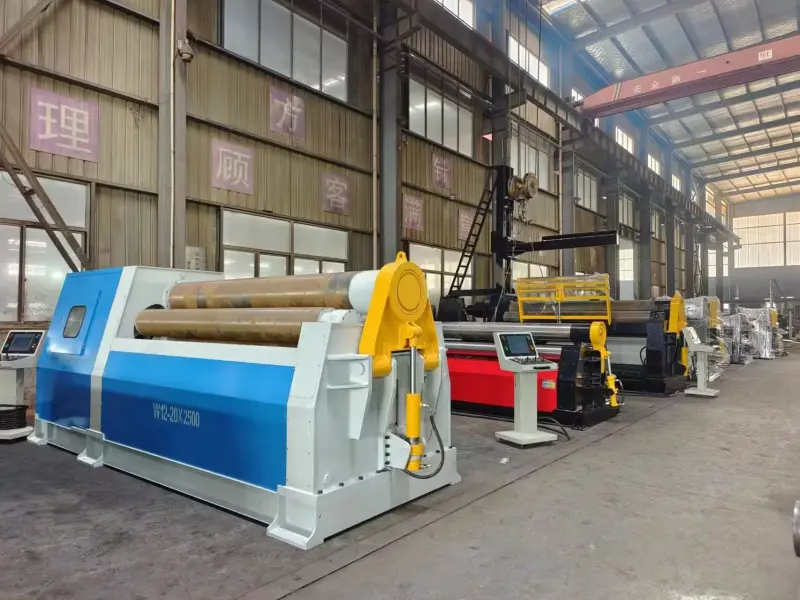


A buyer sees “125 tons × 4,000 mm” on a used press brake listing and assumes the machine forms any steel sheet placed under the ram. Then 10 mm plate cracks the dies, the bed bows in the middle, and the money is already spent.
A used 125-ton press brake bends 4-meter steel sheets by driving two synchronized hydraulic cylinders down a 4,000 mm bed. Across the full four meters it air-bends roughly 3–4 mm mild steel; heavier plate like 10 mm needs a shorter, centered span or a wider V-die.
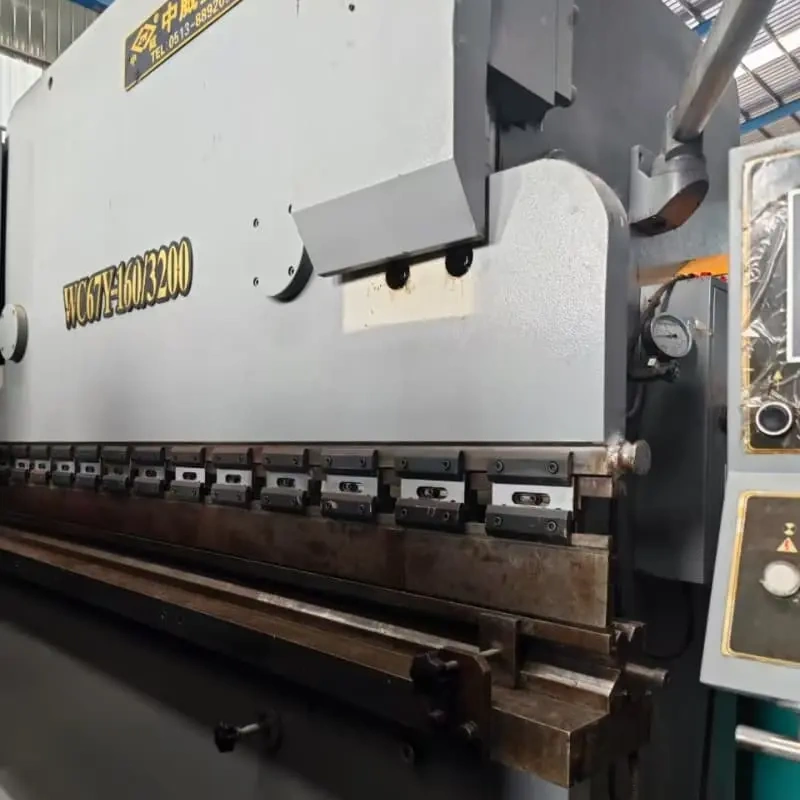
I inspect used press brakes for a living here in Liaocheng, and this exact misunderstanding — treating the tonnage figure and the bed length as one number — causes more bad purchases than any worn seal ever will. The tonnage and the length work together, and they trade off against each other in a way every fabrication-shop owner should understand before wiring a deposit. Let me walk you through the physics, the mechanics inside the frame, and the inspection routine I run before any 125-ton machine leaves our yard.
How Much Tonnage Does a 4-Meter Steel Sheet Really Need?
A buyer who plans around the nameplate number alone will buy a machine that is either always on its pressure relief valve or never working at its real capacity. Bending force scales with thickness squared, and it also scales with bend length, so a 4-meter sheet is a very different job from a 1-meter one.
Tonnage for air bending mild steel follows P ≈ 650 × t² × L ÷ V, where t is thickness in mm, L is bend length in meters, and V is the die opening in mm. A 4-meter bend of 4 mm mild steel with a 32 mm V-die needs about 132 tons — right at the edge of a 125-ton machine.
The Formula Behind the Nameplate
The 650 in the formula is a planning constant for mild steel around 450 MPa tensile strength, air bending at 90 degrees. It is not a certificate, and it is not exact, but it is the number most tonnage charts are built on, and it matches what I see in real bends. Divide the kilonewton result by 9.8 to get metric tons.
The V-die opening is the variable most buyers forget. Fabricators usually pick a V opening between 6 and 10 times the material thickness; 8 times is the common default. A wider opening lowers the required tonnage but raises the inside radius and the minimum flange length. A narrower opening supports short flanges but pushes tonnage up sharply. So the same sheet can need very different force depending on which die sits in the bed that day.
Material changes the math too. Stainless steel 304 or 316 needs about 1.4 to 1.6 times the force of mild steel and springs back more. Aluminum 5052 needs roughly half. High-strength steel can demand 1.8 to 3 times, which is why I always ask buyers to send the material grade and the mill certificate, not just “6 mm plate”. Two coils of S355 from different mills can differ enough to change the bend result.
What a 125-Ton Machine Can Actually Bend at Full Length
Here is the honest arithmetic. A 125-ton rating is about 1,226 kN of total force. Spread over a 4-meter bend, that is roughly 31 tons per meter. Compare that with standard air-bending chart values for mild steel and you get a clear picture of where the full-length limit sits.
| Thickness (mild steel) | Typical V opening | Load per meter | Load at full 4 m | Verdict on a 125-ton brake |
|---|---|---|---|---|
| 3 mm | 24 mm | 25.3 t/m | 101 t | Comfortable, ~81% of rating |
| 4 mm | 32 mm | 33.7 t/m | 135 t | Over rating — needs a wider V or shorter span |
| 6 mm | 48 mm | 50.5 t/m | 202 t | Only across ~2.4 m centered |
| 8 mm | 64 mm | 67.4 t/m | 270 t | Only across ~1.8 m centered |
| 10 mm | 80 mm | 82.9 t/m | 332 t | Only across ~1.5 m centered |
| 12 mm | 120 mm | 67.4 t/m | 270 t | Only across ~1.8 m centered |
This table is why I tell buyers the same thing every week: a 125-ton × 4-meter machine is a long-sheet machine, not a thick-plate machine. It forms 3 mm sheet across the full bed all day, and it forms 10 mm plate only in centered sections shorter than about 1.5 meters. Listings that claim “bends 12 mm mild steel” are quoting the thickest possible single bend, not a full-length capability. The reverse machine — say 320 tons × 3.2 meters — is the thick-plate choice. Neither is better; they answer different part mixes.
The 80% and 60% Rules
Two working rules keep a used machine alive for years. First, plan for no more than 80% of rated tonnage on your most frequent job. A 125-ton machine should see about 100 tons or less in daily production. That 15–30% margin absorbs material variation, die wear, and the tensile spread inside a single grade. A machine run at 100% of rating every cycle will hammer its frame, its seals, and its relief valve until something expensive fails.
Second, respect the centered-load rule. Most manufacturers say you should never apply full tonnage over less than about 60% of the distance between the side frames. Bending a short, thick part dead center with full force is the classic way to upset a ram. I have seen rams bowed upward in the middle by exactly this habit, and no crowning system fixes a warped ram. If your product mix includes short heavy parts, either center them within the rule or buy more tonnage.
explore our used press brake stock is where I would send you next if your part mix is mostly long, thin sheet — the machines are cheaper than you might expect.
What Happens Inside the Machine When the Ram Comes Down?
Tonnage numbers explain the load, but buyers rarely ask what physically keeps a 4-meter ram level while 125 tons squeeze through it. That question matters more on a used machine than a new one, because synchronization wear shows up as angle error on every long part you form.
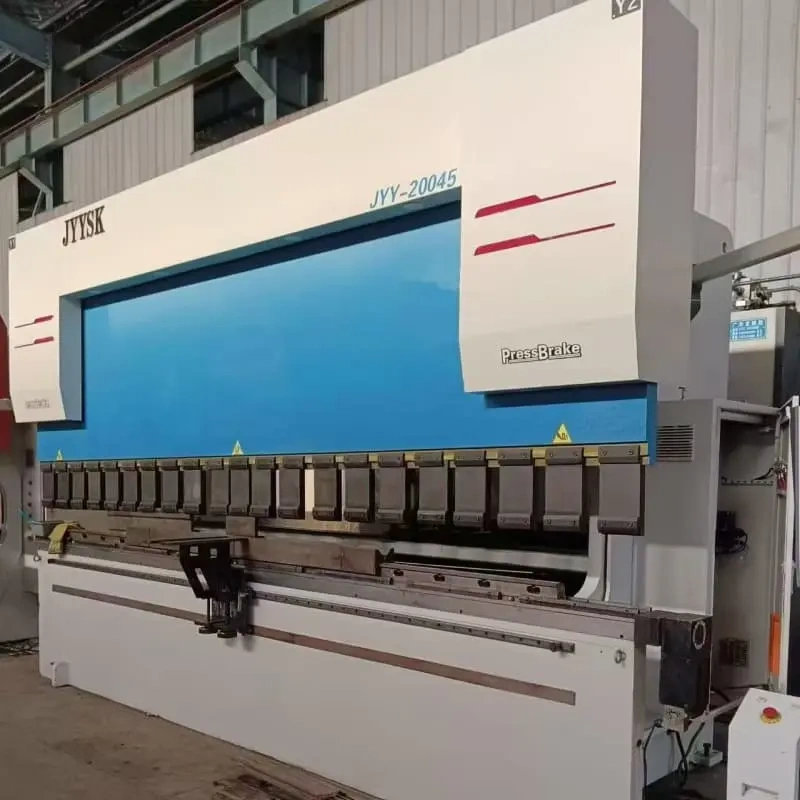
Two hydraulic cylinders at the frame ends drive the ram, and a synchronization system keeps both sides level across the 4-meter span. Torsion-shaft machines link the cylinders mechanically; CNC electro-hydraulic machines close the loop on each side with encoders and proportional valves, holding parallelism tighter on long bends.
Torsion Shaft vs Y1/Y2 Synchronization
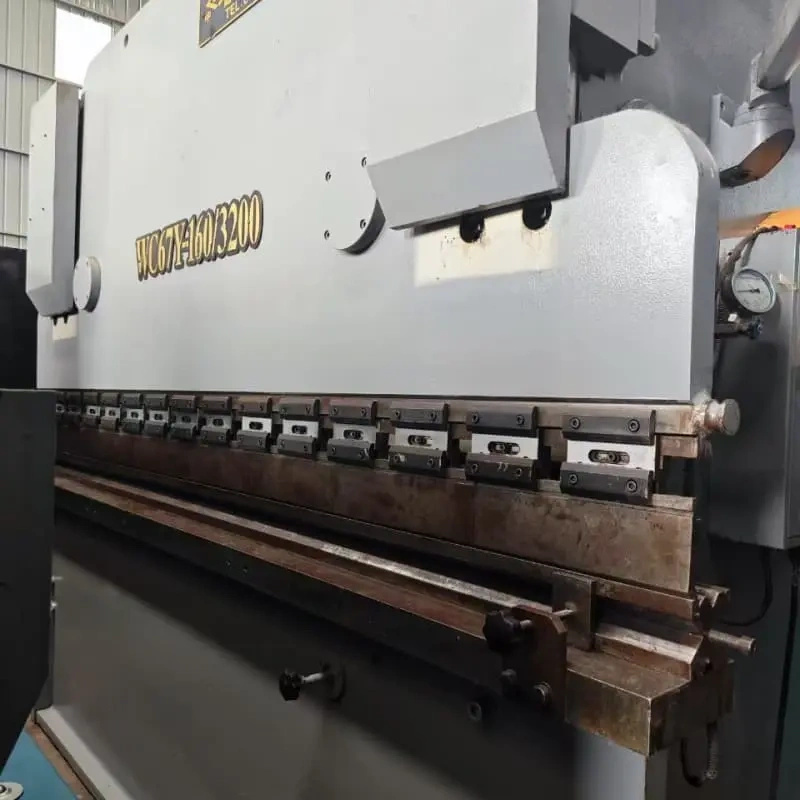
Most used 125-ton machines in the Chinese market are WC67Y or WC67K series frames, and they come in two flavors. The torsion-shaft type ties both cylinders together with a steel shaft through the frame. It is simple, durable, and cheap to repair, and it holds ram parallelism well enough for structural and enclosure work. The electro-hydraulic type runs a Y1/Y2 closed loop: linear encoders on each side feed a controller like a Delem DA-52S or E21, and proportional valves trim each cylinder independently.
| Feature | Torsion shaft (WC67Y) | Electro-hydraulic Y1/Y2 (WC67K) |
|---|---|---|
| Synchronization | Mechanical shaft | Encoders + proportional valves per side |
| Parallelism on 4 m span | Good, fixed | Better, self-correcting |
| Crowning support | Manual wedge only | Motorized or hydraulic tables |
| Controller | Digital display / E21 | DA-52S, DA-58T class CNC |
| Repair cost when worn | Low — shaft and bushings | Higher — valves and scales |
| Best fit | Repetitive structural work | Long accurate parts, mixed angles |
Neither system is “the better one”. A torsion-shaft machine that has led a gentle life will outbend a neglected electro-hydraulic machine every time. But on genuinely long parts — 4-meter panels, truck beds, stair stringers — the closed-loop system corrects the small left-right differences that make one end of a bend half a degree off the other.
Deflection and Crowning Over a 4-Meter Span
Steel is not infinitely stiff. Under load, the ram and bed of any press brake bow slightly, and the bow grows with span and with tonnage. On a 4-meter machine, an unloaded bow at the center of a few tenths of a millimeter becomes a visible angle difference across a full-width bend once you add force. That is physics, not defect — new machines do it too.
What separates a healthy machine from a tired one is whether the bow is elastic or permanent. Elastic deflection disappears when the ram comes up. Permanent deflection — the “swayback” bed or the upset ram — stays, and it puts a fixed error into every part. Crowning tables compensate for elastic bow and even for modest permanent bow, by presetting the die rail higher at the center. On used machines I measure the unloaded bow first, because crowning has limits; a bed sagging half a millimeter before you even load it is a re-machining job, not a crowning job.
I look at the part mix here too. A buyer making mostly 3 mm enclosure panels over the full length needs a machine with decent crowning more than a buyer making short brackets. Ask which parts the machine actually bent for its previous owner, then ask whether those parts resemble yours.
The Hydraulic Circuit That Delivers 125 Tons
A 125-ton machine with two cylinders typically runs a 7.5 to 11 kW motor feeding a circuit around 25 MPa, with fast approach at roughly 100–120 mm/s, working speed near 10 mm/s, and return around 80 mm/s. Stroke is usually 150–200 mm with an open height of 350–400 mm, and an electric backgauge travels about 500 mm on the X axis. These numbers matter less for capability than for cycle time on your real parts.
The circuit is also where a used machine hides its age. Worn piston seals let oil bypass inside the cylinder, which shows up as ram drift under load and as a machine that cannot hold dwell at the bottom of the stroke. A failing pump drops maximum pressure — the tonnage quietly shrinks from 125 toward 110 and nobody writes it down. Milky or burnt oil, scored chrome rods, and weeping rod seals are all evidence, and none of it shows in a three-cycle demo with no load. see how we document hydraulic tests before export for the video evidence I send every overseas buyer.
What Should You Check Before Buying a Used 125-Ton 4-Meter Press Brake?
A used 125-ton press brake costs 40–60% of a new one, which is exactly the discount that tempts buyers into skipping inspection. On a machine this size, the three failure zones are the frame, the hydraulics, and the control-backgauge pair, and each one has a test you can run in half a day.
Check a used 125-ton press brake in this order: straightedge and feeler gauge on the ram and bed, cylinder drift and parallelism under load, oil condition, then backgauge repeatability and control parts availability. A 0.15 mm gap under the straightedge at ram center means walk away.
Structure: Flashlight, Straightedge, and Feeler Gauges
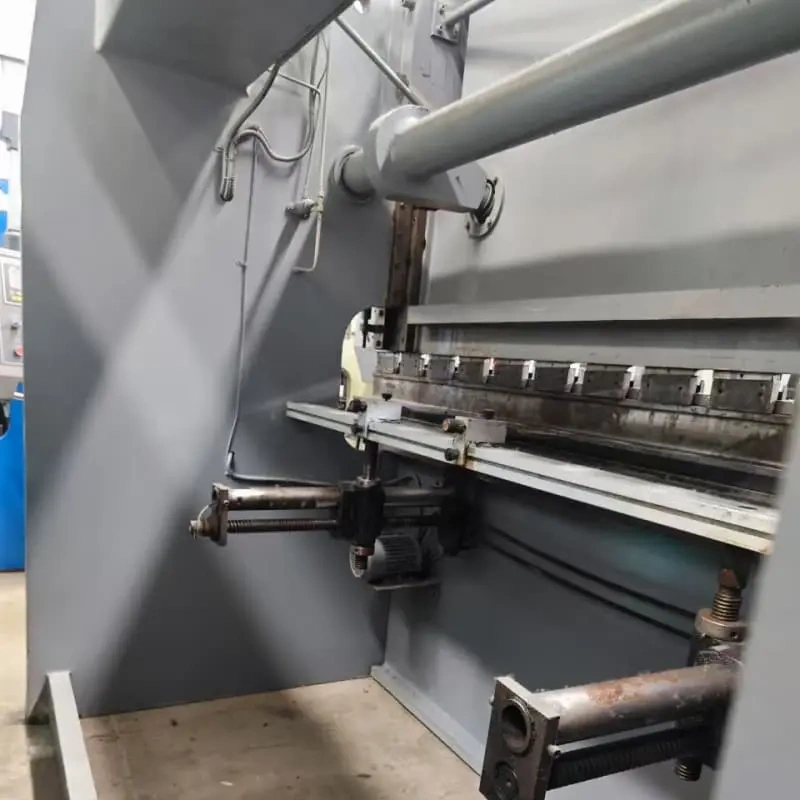
Remove the tooling first. Lay a precision straightedge — at least a meter of it — along the ram’s tool-seating surface and shine a flashlight from behind. Light leaking through the center while the ends sit flush means the ram has been upset, almost certainly by years of short heavy parts bent at full force. I measure the gap with feeler gauges, and at 0.15 mm I stop the conversation. Grinding a ram back is possible but rarely economic.
Then check the bed the same way, ideally with a laser level or a taut wire stretched between two blocks at the ends. Measure every 500 mm. Deviation beyond about 0.10 mm per meter means the bed needs re-machining, and on a 4-meter machine that is real money — often in the thousands of dollars. While you are down there, sweep the bed with a dial indicator on a magnetic base and watch the needle; a permanent valley at center span is the signature of a machine that bent plate where it should not have.
The side frames tell their own story. Paint flaking in a spiderweb pattern near the throat means the steel stretched past its elastic limit somewhere in the past. Stress blushing like that does not heal, and the frame will “give” differently on every stroke. I also cycle the ram through full stroke and listen: a clunk at reversal or visible side play in the guides means the guide clearance has gone beyond adjustment.
Hydraulics: The Hot Run and the Drift Test
Hydraulic oil is forgiving when cold and honest when hot, so I never judge a machine from a cold demo. Run it under real load — bend scrap — for 30 to 45 minutes until the oil reaches its 45–55°C working range. Then watch three things. A ram that returns slowly when hot is bypassing through worn seals or a tired pump. A maximum pressure that drops between cold and hot readings means internal leakage. A high-pitched whine under load is cavitation, and a rhythmic clack is often a broken valve spring.
The cylinder drift test settles the seal question in fifteen minutes. Bring the ram down near bottom dead center under pressure, shut the motor off, mount a dial indicator against the ram, and wait. Roughly 2 mm of drift in fifteen minutes means severe seal failure, and repacking both cylinders is a maintenance line item you must price into the deal — on machines this size it is usually thousands of dollars, not hundreds. Pull the oil sample too; a $50 lab test once saved me from a beautifully repainted machine whose tank held bronze and steel particles from a pump that was actively destroying itself.
Controls, Backgauge, and Tooling
The backgauge takes more abuse than anything else on the machine, because operators lean on it all day. Cycle it to the same position ten times and watch repeatability with a dial indicator; drift beyond a couple of thousandths of an inch means lead screws or guides need work. Bent fingers are visible, so look.
Write down the exact control model before you negotiate. Older Delem, Cybelec, and ESA controls are serviceable, but replacement boards vary from easy to impossible to source. A modern retrofit — say a DA-58T onto a 1990s frame — is a legitimate path and gives the machine another decade, but budget it honestly. Ask for the parameter list and any software backups; a dead battery without backups can turn the control into an expensive display.
Tooling completes the value. A full set of matched punch and die sections for a 4-meter machine easily runs into five figures new, so included tooling shifts the deal. Match the die set against your part list, not the seller’s. Here is how a used machine stacks up against a new equivalent:
| Factor | New 125T × 4000 mm | Used 125T × 4000 mm |
|---|---|---|
| Purchase price | Baseline | Typically 40–60% of new |
| Delivery lead time | 8–20 weeks from order | Days to weeks from stock |
| First-year depreciation | Steep — 15–20% early | Already taken by first owner |
| Condition risk | Warranty-backed | Depends entirely on inspection |
| Hidden costs | Installation only | Reseal, regrind, control retrofit, light curtain $4–10k |
| Best for | Stable long-run production | Buyers who inspect and price repairs honestly |
The used route wins on capital and speed; the new route wins on certainty. I sell used machines for a living, and I still tell buyers the same thing: the discount is the payment you receive for doing the inspection yourself. Do it well and the used 125-ton 4-meter brake is one of the best value-per-ton purchases in metal fabrication. Skip it and the discount becomes a repair fund with a delivery date.
Conclusion
Understand the tonnage-length trade-off, test the frame and hydraulics under load, and a used 125-ton press brake will bend your 4-meter steel sheets profitably for years.