

Most fabrication shops overpay for shearing capacity they never use. Buy a 12mm-class shear to cut 5mm plate and you either waste capital or miss the settings that turn that capacity into clean, burr-free edges every shift.
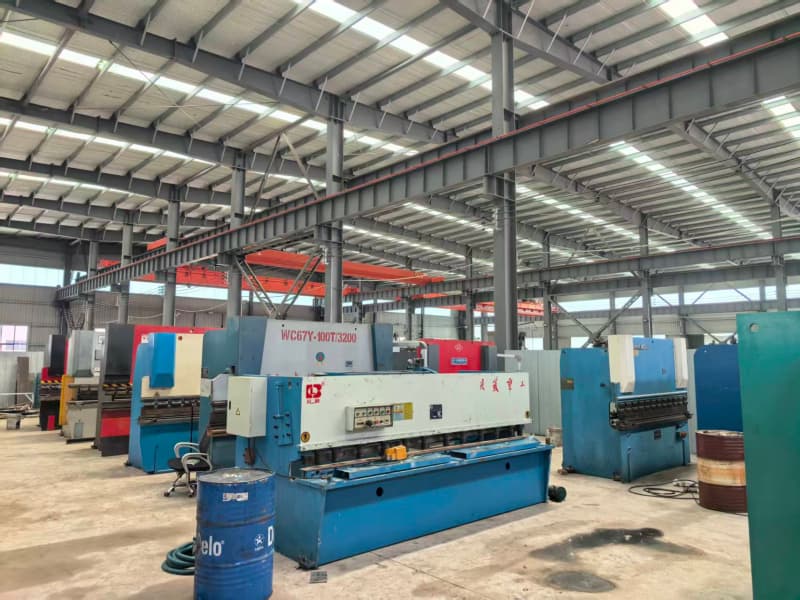
A QC12Y-12×2500 shearing machine cuts 5mm carbon steel by clamping the sheet with hydraulic hold-downs, driving an inclined upper blade through a blade gap of roughly 7–8% of the thickness (about 0.35–0.40 mm) at a 1.5–2° rake angle, and letting the fracture propagate cleanly. At 5mm the machine works at less than half its 12mm rating.
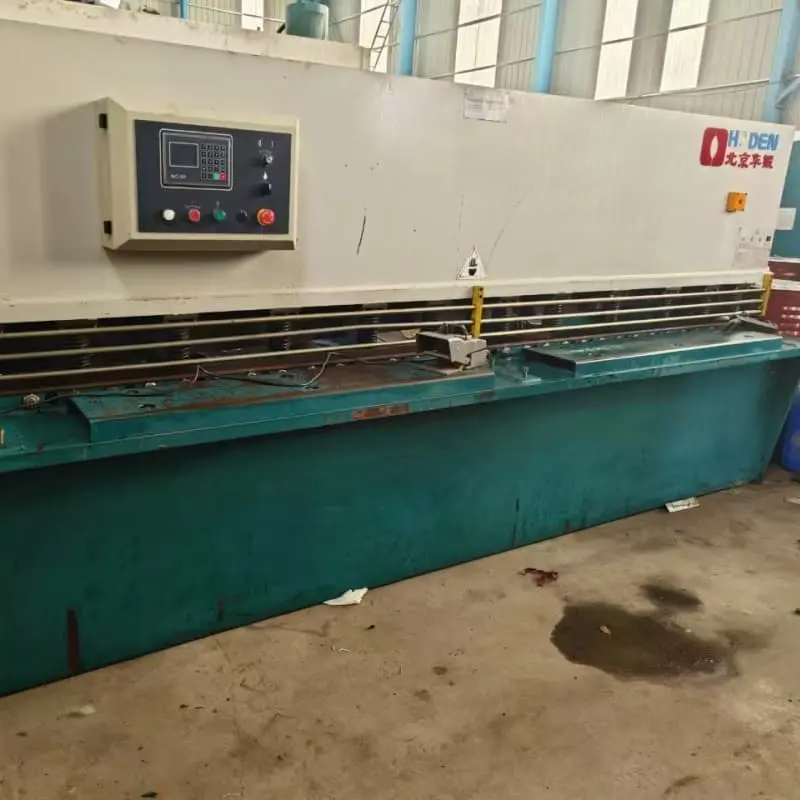
Before we get into the numbers, one naming note that I have to give almost every buyer on a video call. The QC12Y series is, strictly speaking, a swing-beam shearing machine, not a guillotine. The guillotine series from the same Chinese naming system is QC11K, where the blade beam moves straight down on guided ways. But in daily trade talk, buyers from Vietnam to Saudi Arabia call every hydraulic shear a “guillotine shear”, and the title of this article reflects how people actually search. The mechanics I describe below apply to both families, and the differences that do matter are exactly what I will compare in the last section. So keep reading with both pictures in mind, because the physics of cutting 5mm carbon steel is the same either way. What changes between swing beam and guillotine is how the blade travels, and that mostly affects long, narrow cuts rather than ordinary 5mm blanks.
Why Does a 12mm-Rated Shear Barely Notice a 5mm Plate?
Buyers see “12×2500” on the nameplate and assume a 5mm job is a light warm-up. Then they either buy a machine twice the price they needed, or they distrust the rating and pay for capacity that sits idle all year.
A QC12Y-12×2500 cuts 5mm mild carbon steel at roughly 40% of its rated load, because shearing force scales with thickness and the inclined rake angle spreads the cut over a long diagonal. The machine never approaches its structural or hydraulic limits on 5mm work.
The Force Math Behind the Rating
The rating on the nameplate means this: full-width, 2500 mm of cut, in mild steel with a tensile strength up to about 450 N/mm², in one stroke. That is the worst case the frame and the hydraulic system were designed for. Your 5mm job sits far inside that envelope.
The quick estimate for straight-cut shearing force is F = 0.6 × L × t × UTS, where L is cut length, t is thickness, and UTS is tensile strength. Run the numbers for a full 2500 mm cut in 5mm plate at around 410 N/mm²: 0.6 × 2500 × 5 × 410 gives roughly 3,000 kN, about 300 tonnes. That sounds like a lot, but the rake angle changes everything. With the blade set at 1.5–2°, the cut progresses along a long diagonal, so only a fraction of the blade edge is actually deforming metal at any instant. Peak force drops to roughly a third of the straight-cut figure, which is exactly why a machine running a 15–18.5 kW motor at 25 MPa hydraulic pressure handles a 12mm full-width cut at all. On 5mm plate, the hydraulic system barely raises its voice. I have stood next to our test bench while a QC12Y-12×2500 took 5mm Q235 all morning, and the pump tone does not change between 3mm and 6mm — the operator changes, because the good ones slow the stroke down for edge quality, not because the machine struggles.
What the Rating Assumes, and Where 5mm Fits
| Material on a 12mm / 2500 mm shear | Effective thickness vs rating | Practical verdict |
|---|---|---|
| Q235 / A36 mild steel, 5mm | ~42% of rating | Comfortable all-day production |
| Q345 / S355, 5mm | ~50% of rating | Comfortable, keep the gap 8–10% |
| 304 stainless, 5mm | ~60–70% derate → behaves like 7.5–8.5mm mild steel | Fine, but watch blade wear and work hardening |
| Hardox-type wear plate, 5mm | ~50% derate → behaves like 10mm mild steel | Near the practical limit of a swing beam |
| Mild steel, 12mm | 100% of rating | Full-load territory, test before you commit |
The stainless and Hardox rows are the ones buyers get wrong. A 5mm stainless sheet does not care that the machine is rated at 12mm of mild steel, because stainless work-hardens as the blade penetrates and fights back through the whole stroke. Our rule for customers who mostly cut 304 is to treat the machine as a 7mm machine and keep the blades sharper than they would for mild steel. If your actual week is 5mm carbon steel, though, you have bought headroom, not a bottleneck. Our current used shearing machines in stock cover exactly this class of work, and most have already passed a 5mm test cut on our floor. That headroom is worth money, and I will price it at the end of this article.
Which Settings Decide Whether the Edge Is Clean or Covered in Burrs?
Two shops can cut the same 5mm plate on the same model and get completely different edges. One ships blanks straight to welding; the other grinds every piece by hand and blames the machine.
The three settings that decide edge quality on 5mm carbon steel are blade gap (about 0.35–0.40 mm per side), rake angle (1.5–2° for this thickness), and hold-down condition. Read the four zones of the cut edge — rollover, burnish, fracture, burr — and each setting tells you where it failed.
Blade Gap: The 0.35 Millimetre That Decides Everything
Clearance is the horizontal gap between the upper and lower blade edges, and for 5mm mild steel the common guidance lands at 7–8% of thickness, so 0.35–0.40 mm per side. You will find sources that say 5–8% and others that say 8–10% for this range — the honest answer is that blade geometry, material batch, and how worn the edge is all shift the optimum. The machine plate on a QC12Y gives a gap table by thickness; start there, then confirm with a test cut and adjust in 0.02–0.05 mm steps. Too tight and the edge shows a double burnish band, the machine strains, and the blades chew each other. Too loose and the material tears instead of shearing, leaving a heavy burr on the bottom edge.
One detail from our floor that rarely makes the manuals: the gap must be consistent along all 2500 mm. I have inspected machines where the gap was correct at the middle but almost double at one end, because the blade seats had been damaged or the adjustment linkage was worn. That machine cut beautiful 300 mm blanks and terrible 2400 mm blanks, and nobody could work out why until I ran a feeler gauge down the blade in six positions. If a used machine’s gap cannot be brought within a few hundredths across the full length, the blade seats need machining — price that repair before you buy.
Rake Angle and Hold-Downs: The Quiet Partners
For 5mm carbon steel, a rake of 1.5–2° is the working range. A steeper rake cuts easier on thick plate but twists and cambers long narrow strips; a shallower rake keeps thin sheet flat but asks more force from the hydraulics. At 5mm you are in the middle of the range, so most machines ship set about right — what matters on a used machine is whether the setting mechanism still holds its position under load.
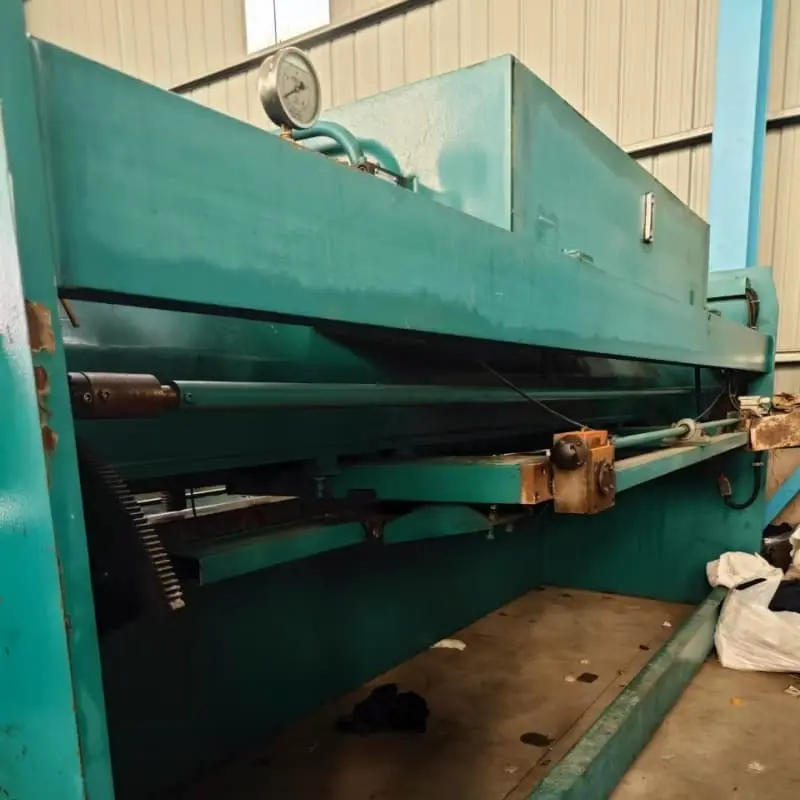
Hold-downs are the setting people forget entirely. A QC12Y-12×2500 carries a row of hydraulic hold-down cylinders ahead of the blade, and if even one of them has a weak seal or a worn pad, the sheet lifts on that side during the cut. The result is a tapered edge and a heavy burr concentrated on one end of the blank — and because the fault moves with the hold-down, not with the gap, buyers often misdiagnose it as a blade problem. On every used shear we inspect, I press each hold-down foot by hand cycle and watch the gauge; they should all bite with similar force, and none should lag.
Reading the Four Zones of a Sheared Edge
| Zone on the cut edge | Healthy share on 5mm mild steel | What it tells you |
|---|---|---|
| Rollover (rounded top edge) | Under ~15% of thickness | Excess means gap too wide or blade dull |
| Burnish (bright polished band) | 1/3 to 1/2 of thickness | The clean-cut signature; two bands = gap too tight |
| Fracture (rough angled zone) | The remainder, fine-textured | Coarse tearing = gap too wide or penetration shallow |
| Burr (raised lip) | Under ~10% of thickness, ideally well under | Bottom burr = gap too loose; one-sided = hold-down fault |
Learn to read that cross-section with a hand lens and you never need to guess at a used machine again. The burnish band is the part the blades actually sheared; the fracture zone is where the crack ran ahead of the blade. On a healthy 5mm cut the transition between them sits roughly mid-thickness and the fracture face is fine and even. My own shortcut after years of this: run one test blank, snap it clean across the cut line, and look at the two halves under a cheap 50× USB microscope. Ten minutes of looking tells me more about a machine’s real condition than an hour of the seller’s talk.
What Should You Check on a Used QC12Y-12×2500 Before Cutting Real Production Plates?
A used shear can look flawless in photos and still ship you a month of burr problems. The failure points are specific, they are checkable, and none of them require a laboratory.
Check the frame welds, blade edges, hold-down force, hydraulic oil condition, a ten-minute pressure hold, controller alarms, and then demand a loaded test cut on 5mm plate with a burr measurement and a backgauge repeatability check. If the seller refuses the test cut, walk away.
Frame, Blades, and Hold-Downs
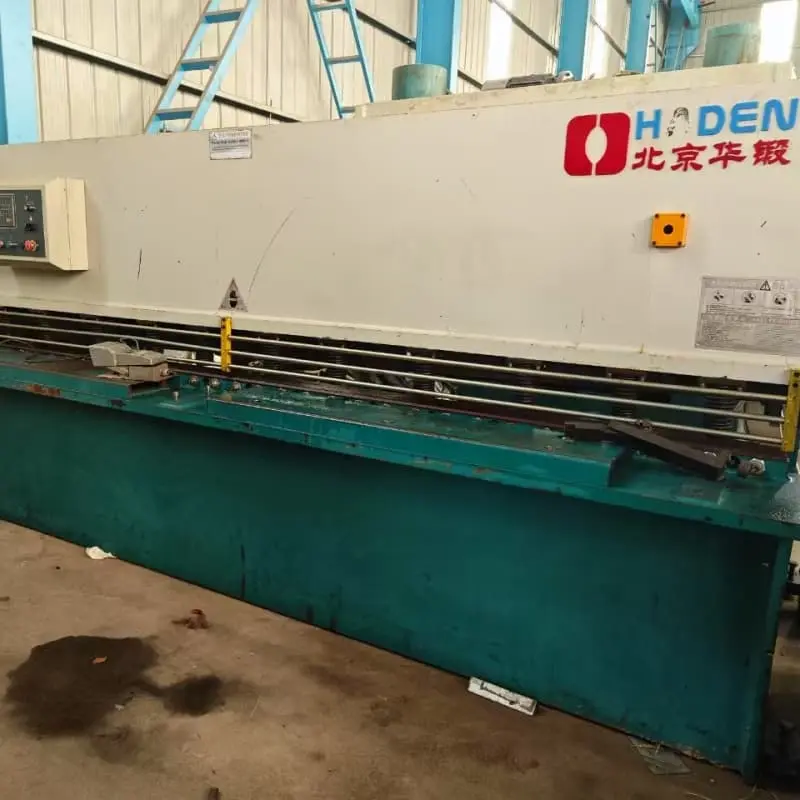
Start at the frame. Welded shear frames carry enormous repeated load, and overload cracks show up first around the throat corners and the lower blade seat. Look for paint that has been touched up in straight lines — that is how repaired cracks hide. The blades themselves matter as much as the machine: a QC12Y blade set has four usable edges, and each edge can be reground a few times before it is done. Run your fingernail across the edge; chips and rounded sections are easy to feel. Factor blade condition into the price — a new blade set for this class costs real money, and reground blades shorten the interval to the next grind.
Check the hold-down pads for wear and the pads’ contact with typical sheet. Then watch a stroke with the sheet in place: all hold-downs should clamp before the blade touches metal, not during. On machines that have sat idle for months, hold-down seals dry out and leak internally, which is invisible until the sheet starts tilting mid-cut.
Hydraulics Tell the Truth
The oil tells you how the machine was treated. Milky oil means water in the system. Dark, burnt-smelling oil means it ran hot or was never changed. Neither is a reason to refuse the machine by itself, but both are negotiation points, because a full oil change and filter set is your cost. Then run the pressure test: bring the system to working pressure, stop, and watch the gauge for ten minutes. A small drift is normal; a steady drop points to internal seal leakage in the cylinders or the directional valve. While it runs, listen to the pump — a rising whine at pressure usually means the pump is on its way out.
Electrical and safety checks are quick but non-negotiable. The controller on this class is typically an Estun E21S — power it cold, not warm, and watch for alarm codes. Press the E-stop, test the foot switch, confirm the finger guard or light curtain does its job. Spare parts for the standard components (Rexroth or Sunny valves, Schneider electrics) are available worldwide, which is one reason we like this platform for export customers.
The Test Cut Protocol
Then insist on the loaded test cut, filmed if you are buying remotely: 5mm Q235, full width if the seller allows it. Measure the burr height along the blank in five places — it should be small, even, and identical at both ends. Check squareness against a machined square. Jog the backgauge through twenty cycles and confirm it returns to the same position every time; a backgauge that drifts even half a millimetre ruins batch work. Every used machine we ship goes through this exact sequence, and I will tell you plainly: the single most revealing moment in buying used machinery is watching whether the seller reaches for the test plate before you ask. [Zora will replace — insert concrete test-cut result from a recent QC12Y inspection, with burr readings]
Is a Used Swing Beam Shear Actually the Right Buy for 5mm Work?
You know the machine can cut 5mm and you know how to check one. The last question is money: whether the swing-beam design is the right platform for this work, or whether you should pay extra for a true guillotine.
For 5mm carbon steel, a used QC12Y swing-beam shear is usually the right buy: it runs far inside its rating, used prices sit well below guillotine equivalents, and maintenance is simple. Choose the guillotine only when you need maximum straightness on long, thin, precision blanks.
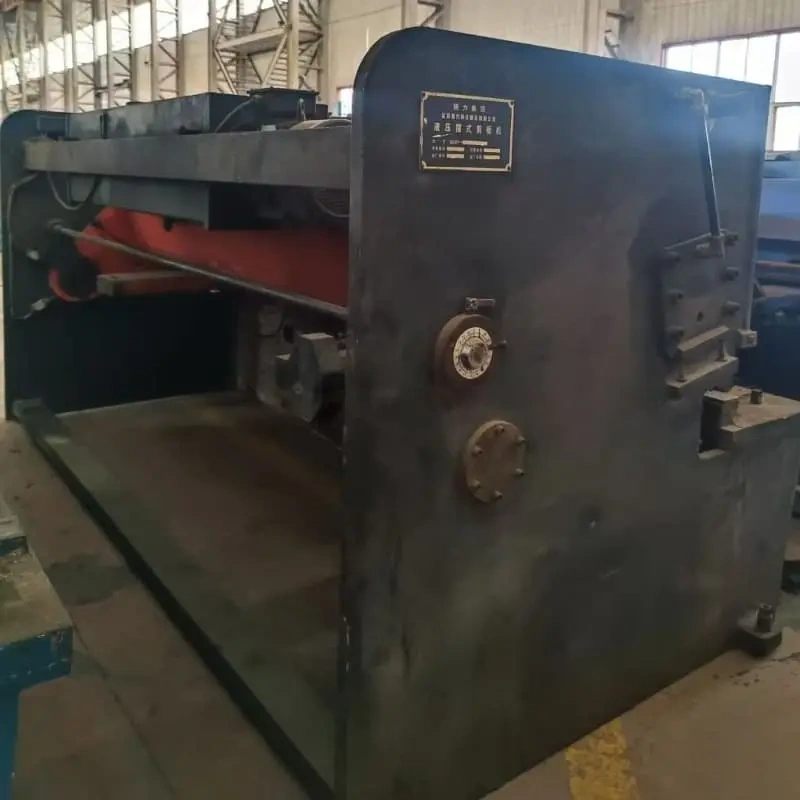
Here is the honest comparison, from a seller who ships both types:
| Point of comparison | Swing beam (QC12Y series) | Guillotine (QC11K series) |
|---|---|---|
| Blade travel | Beam pivots on an arc, blade withdraws on return | Beam moves straight down on guided ways |
| Rake angle | Fixed or coarsely adjustable (0.5–2.5°) | Often adjustable in finer steps |
| Long narrow blanks | Slight twist possible on very long, thin cuts | Straighter cuts on long narrow strips |
| Blade life | Very good — arc withdrawal drags less grit across the edge | Good, but full-length contact wears edges faster |
| Maintenance | Simpler hydraulics, fewer precision guide surfaces | More precise ways to keep aligned |
| Used price, 12×2500 class | Roughly USD 8,000–20,000 | Roughly USD 15,000–40,000 and up |
Those price bands move with condition, region, and how much refurbishment the machine has had, so treat them as orientation rather than quotes. But the direction is reliable: for a shop whose real daily work is 5mm blanks at 1500–2500 mm lengths, the swing beam gives up very little and costs meaningfully less. One of our regular customers, Gulf Industrial Equipment LLC in Saudi Arabia, has bought used shearing machines and bending machines from us across several projects, and their pattern matches what I see across the Gulf and Southeast Asia: they buy the class that covers the majority of their plate, not the class that covers the worst-case drawing. Their first order nearly stalled because an earlier supplier would not send running videos — by the time they came to us, they wanted the test cut on camera, the SGS inspection booked, and export packing with anti-rust protection before any balance payment. That is exactly how it should be done, and a machine that passes the protocol in the section above will pass it on camera too.
Also do the blade arithmetic before you sign anything. Blades sharpen every 500–1,000 cuts on mild steel, four edges per set, three or four regrinds per edge — so a used machine with a worn set still has a long, cheap life ahead of it if the seats are sound. Budget for the first oil change and a set of filters on arrival, and the running cost of 5mm work on this class of machine is close to trivial compared with outsourcing the cutting. If your blanking line feeds a bending cell, our used press brake buying guide picks up exactly where a sheared blank ends.
Conclusion
A QC12Y-12×2500 cuts 5mm carbon steel with room to spare — set the gap to 7–8%, hold the rake near 2°, verify the hold-downs, and prove it with a measured test cut before you pay.