

Large shafts fail in the middle. A used lathe that swings the diameter but cannot hold the line turns a forging into scrap. Here is how we test that.
A used lathe handles large-diameter steel shafts when its swing, spindle bore, bed width and steady-rest tooling match the part, and when the bed is straight enough to hold taper under 0.02 mm per metre under a real cut. Paper capacity is not cutting capacity.
Big shaft work looks simple from the outside. You chuck a heavy blank, you take a cut, you measure. What the catalogue cannot show you is how the machine behaves when the tool is 800 mm from the headstock, the shaft weighs four tonnes, and the radial force is pushing the workpiece away from the insert. That is where a used lathe either earns its price or becomes an expensive lesson. I sell these machines for a living, and I have watched buyers walk past a good machine because the paint was dull, then pay too much for a shiny one with a dished bed. So let me walk you through what actually decides the outcome.
What Actually Limits a Used Lathe on Large-Diameter Shafts?
Catalogues quote swing over bed. That number only clears the part. Clearance is where the trouble starts, not where it ends.
Swing over bed is clearance. Real capacity comes from swing over the cross slide, bed width, spindle bore, chuck mass, and the weight the tailstock and steady rests can carry without deflecting.
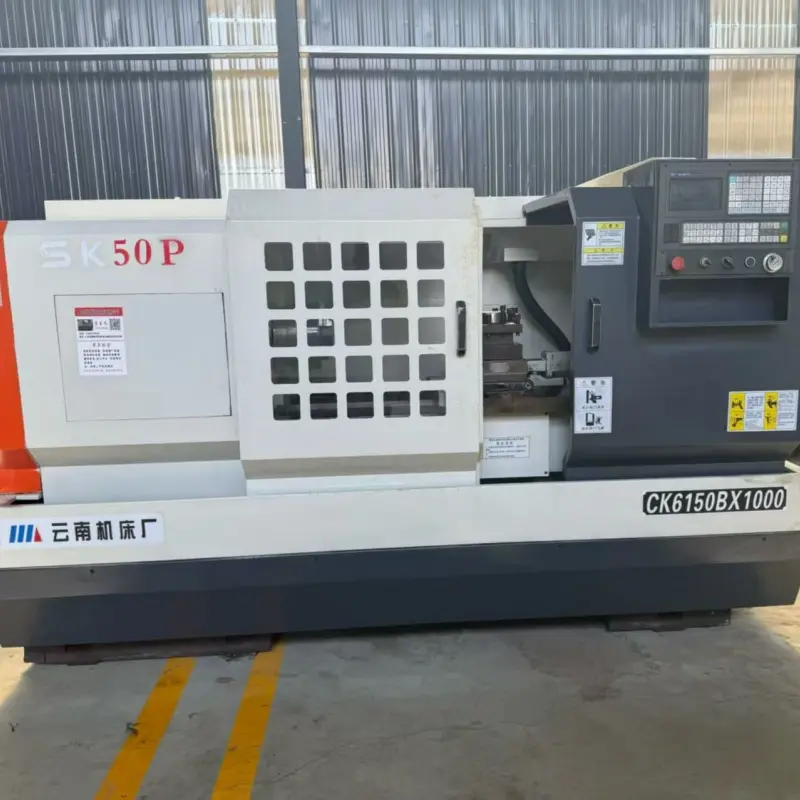
A 1250 mm swing sounds generous until you put a tool holder, a boring bar or a wide facing tool into the equation. The cross slide eats 300 to 400 mm of that number on a typical gap-bed machine. Then the steady rest jaws eat another 60 to 100 mm. What is left is the diameter you can actually turn, and it is usually 30 to 40 percent smaller than the headline figure.
Three Diameters, Not One
Every heavy lathe has at least three capacity numbers, and buyers mix them up constantly.
- Swing over bed. The largest disc that will rotate above the ways without touching anything.
- Swing over cross slide. The largest disc that will rotate with the cross slide in its working position. This is the number your tool actually sees.
- Swing in the gap. Only on gap-bed machines. You remove a section of the bed near the headstock to clear a flange or a large coupling. The gap is short, often 300 mm, and it is for facing and short turning only.
On a Shenyang CW62125B, those three numbers are 1250 mm, 850 mm and 1500 mm. A buyer who reads only the first number thinks he can turn a 1.2 m disc anywhere along the bed. He cannot. He can turn it over the gap, within a 300 mm window, and nowhere else. I have seen that misunderstanding cost a customer a full re-quote.
Bed Width Is the Number Buyers Ignore
Bed width sets rigidity more than any other single dimension. A 550 mm bed is a general-purpose lathe. A 755 mm bed with hardened ways is a heavy-duty machine. The difference shows up as twist and vibration under a deep cut, not in the spec sheet.
Wide beds also carry more mass in the saddle. Mass resists the cutting force pushing the tool away from the work. When you turn a 600 mm shaft at 2 mm depth of cut, the radial force can reach several thousand newtons, and something has to absorb it. On a narrow bed, the saddle rocks. On a wide bed, it sits still.
Spindle Bore Decides Whether the Shaft Fits at All
If your shaft is a tube, a hollow roll or a bar-fed part, the bore matters more than the swing. A 105 mm bore is common on 630 mm machines. A 130 mm bore appears on the 1250 mm class. A large CNC slant-bed can reach 185 mm.
Bore also sets how much of the part you can bury in the headstock. Long shafts that pass through the bore need far less tailstock support and far less steady-rest work. That is a real productivity difference, not a footnote.
| Capacity number | Typical 630 mm lathe | Typical 800 mm lathe | Typical 1250 mm lathe | What it means in the cut |
|---|---|---|---|---|
| Swing over bed | 630 mm | 800 mm | 1250 mm | Maximum disc that clears the ways |
| Swing over cross slide | 350 mm | 480 mm | 850 mm | Maximum disc your tool can reach |
| Swing in gap | 900 mm | 1000 mm | 1500 mm | Short facing window only |
| Spindle bore | 105 mm | 105 mm | 130 mm | Bar and tube capacity through the headstock |
| Bed width | 550 mm | 550 mm | 755 mm | Rigidity under heavy radial force |
| Max workpiece weight | ~2000 kg | ~3000 kg | 6000 kg | What the spindle and tailstock will carry |
Those weight figures are typical catalogue values for the class, not a guarantee for a specific machine. Always confirm against the machine plate and the manual, because a 40-year-old lathe with a rebuilt headstock may not carry its original rating. If the seller cannot produce the manual, treat the weight limit as unverified.
How Do You Hold Taper and Chatter on a Long, Heavy Shaft?
Taper is not a mystery. It is deflection you can calculate before you cut. Chatter is the same deflection, arriving faster.
Taper comes from radial force bending the shaft away from the tool, and it grows with the cube of unsupported length. Support the shaft every 1.2 m, split the weight 60/40 between chuck and tailstock, and keep the tool overhang short.
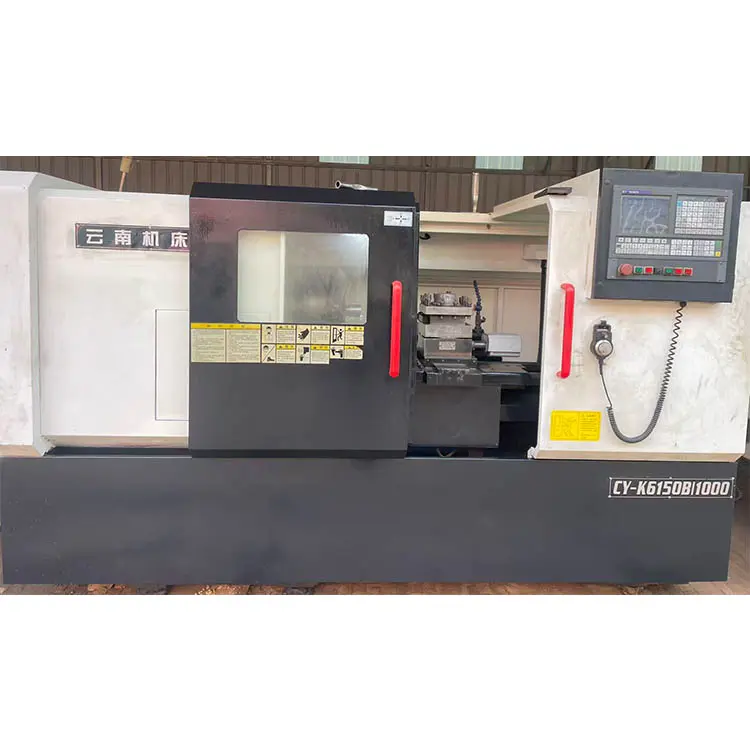
The shop-floor version of the rule is simple. Below an L/D of 3, a chuck alone is fine. Between 3 and 6, you add a tailstock centre for finishing. Above 6, you need intermediate support or you are not going to hold tolerance. Above 10, you are not machining, you are guessing.
The Deflection Maths That Predicts Your Taper
For a shaft held in the chuck only, deflection at the free end is:
δ = F × L³ / (3 × E × I), where I = π × d⁴ / 64.
Two things jump out of that formula. Deflection rises with the cube of length, so doubling the unsupported span multiplies the error by eight. And it falls with the fourth power of diameter, so a shaft that is twice as thick is sixteen times stiffer.
That is why large-diameter work is more forgiving than slender work — and why buyers assume it is easy. It is easier per unit of length, but the forces are far bigger. On alloy shafts from 200 mm to 1200 mm, radial thrust can reach 6000 N. Plug that into the formula with a 3 m span and you get real, measurable taper.
Between centres the formula improves to δ = F × L³ / (48 × E × I) — sixteen times stiffer than a cantilever, because both ends are held. This is the single biggest reason a between-centres setup beats a chuck-only setup on long shafts.
Steady Rest Spacing: One Every 1.2 Metres
The working rule from heavy turning shops is one intermediate steady rest for every 1.2 m of unsupported shaft length. Three-point bronze-jaw rests are the standard, with the jaws lapped to the turned diameter and a light oil film at the contact.
The jaws need a smooth cylindrical band to run on. If your shaft has a keyway, a groove or a shoulder exactly where the rest wants to sit, you either turn a temporary band first or you use a split sleeve. Running a bronze jaw over a keyway is how you get a scored shaft and a vibration mark that no finishing pass will remove.
A published case from a heavy turning workshop makes the value obvious. A 280 mm × 5.2 m mining shaft turned without a steady rest came out with 0.076 mm of taper. With two intermediate steadies the same shaft held 0.008 mm. Same machine, same tool, same operator. The only change was support.
Where the Weight Goes
On a shaft with an L/D of 4 or more, the usual distribution is about 60 percent of the workpiece weight on the chuck and 40 percent on the tailstock centre. Get that wrong and you load the tailstock quill until it deflects, or you hang so much mass on the chuck that the front bearing carries a bending moment it was never designed for.
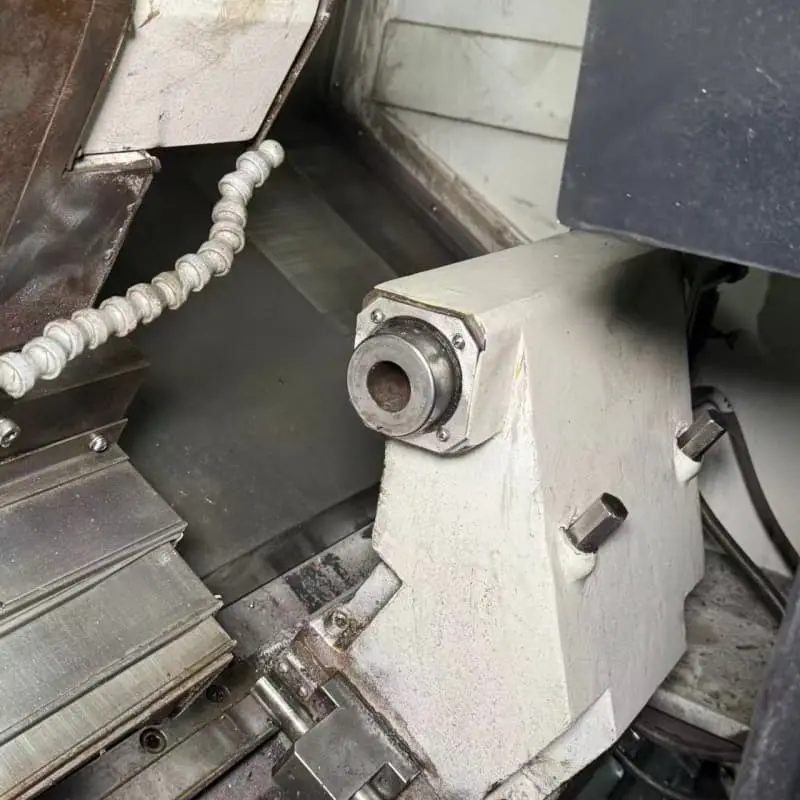
Heavy tailstocks with hydraulic preload solve this properly. The quill applies a constant, adjustable force that counteracts the radial push, so the centre does not walk under a heavy roughing pass. On a manual machine you achieve the same thing with careful quill pressure and a check that you can still stop the centre head with your fingers while the spindle turns.
Thermal Growth Is the Error Nobody Measures
A shaft that has been roughing for two hours is not the same size as a cold shaft. Mid-span can run 0.05 to 0.12 mm larger than the chuck end on a big alloy part, because heat has nowhere to go in the middle.
Three practical countermeasures work. Flood coolant throughout, not just on the finishing pass. Rough, then let the part cool before semi-finishing. And leave 1.0 to 1.4 mm of stock on alloy steel for the finishing passes, so you are removing the stressed, heat-affected layer rather than chasing it.
Cutting data for this class of work is slow by design. Large alloy shafts rough at 60 to 180 rpm, alloy steel at 60 to 150 rpm, with depth of cut held to 2.5 mm on alloy blanks and 2 mm on alloy steel. Finishing runs at 0.1 to 0.18 mm per revolution at 0.3 to 0.6 mm depth. Anyone quoting high spindle speeds for a 600 mm shaft is quoting a number that will chatter.
One more detail that separates a good setup from a bad one: tool overhang. Every extra 50 mm of boring bar or tool holder overhang costs more than 60 percent of the assembly’s rigidity. Keep the tool as short as the geometry allows and the shaft will behave.
| L/D ratio | Behaviour in steel | Support required | What to expect without it |
|---|---|---|---|
| Up to 3 | Rigid | Chuck only | Clean cut, minimal taper |
| 3 to 6 | Slight deflection under heavy cuts | Tailstock centre | Visible taper on finishing |
| 6 to 10 | Severe deflection | Steady rest plus centre | Chatter, poor finish, size drift |
| 10 to 20 | Unstable | Two or more steadies, or between centres | Not machinable to tolerance |
| Above 20 | Self-weight sag dominates | Steadies plus centre, slow speeds | Scrap |
Which Used Lathe Models Suit Large Shaft Work, and What Do They Cost?
Model names matter less than the geometry. But buyers still ask me for names, so here are the families that come through our yard and what each one is actually good at.
A 630 mm gap-bed lathe suits shafts up to about 350 mm and 2 tonnes. An 800 mm machine covers 480 mm and 3 tonnes. A 1250 mm machine covers 850 mm and 6 tonnes. Above that you move to a slant-bed CNC or a roll-turning lathe.
The Chinese CW series is the backbone of this market for a reason. Parts are simple, gearboxes are mechanical, and a competent fitter can rebuild one without a factory technician. That matters when the machine lands in Vietnam or Saudi Arabia and the nearest authorised service centre is a two-day drive away.
The CW6163C Class: The Default Choice
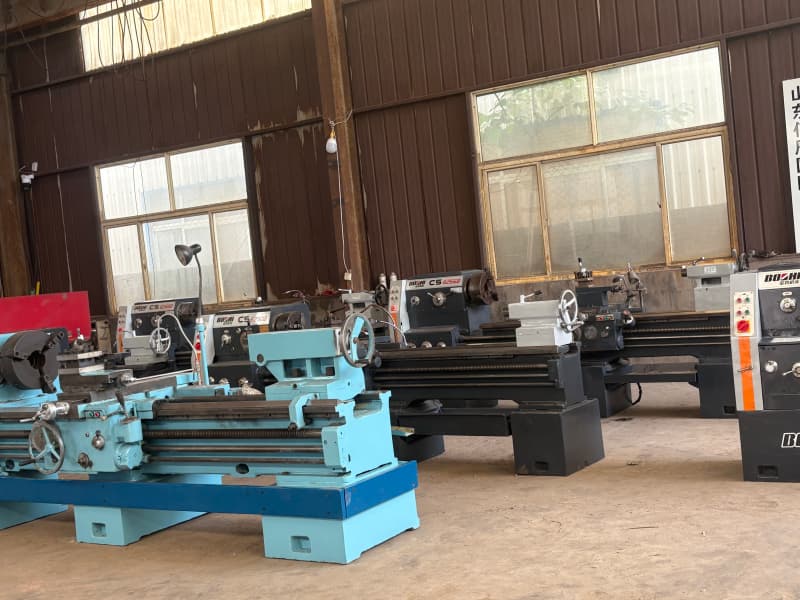
A 630 mm swing, 350 mm over the cross slide, 550 mm bed width, 105 or 130 mm bore, 11 kW motor, 7.5 to 1000 rpm in 18 steps, around 3.8 to 4.2 tonnes. This is the machine most fabrication shops actually need. It will turn a 300 mm shaft all day and handle a 600 mm flange over the gap.
I will be blunt about one thing. Buyers frequently over-buy here. They see a 1250 mm machine in a photo and decide they need it, then discover it weighs 8.5 tonnes, needs a 20-tonne crane to unload, needs a 300 mm foundation, and costs three times as much to ship. If your largest part is a 400 mm roll end, the 630 mm machine will out-earn the big one because it is running instead of waiting for a crane.
The CW6280C and CW62125B: When Diameter Is the Job
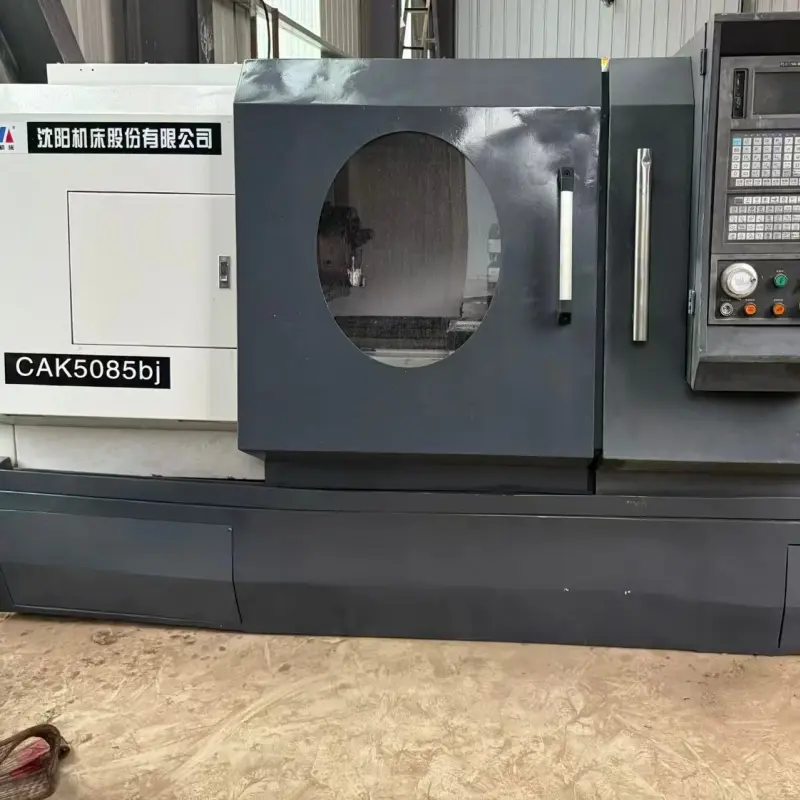
The 800 mm class, such as a CW6280C with 2000 mm between centres, runs 5 to 800 rpm from a 15 kW motor and weighs around 10 to 11 tonnes. It is a genuine step up in rigidity, not just in swing.
The 1250 mm class is a different animal. A CW62125B with a 1500 mm centre distance carries 1250 mm over the bed, 850 mm over the cross slide, 1500 mm in a 300 mm gap, a 130 mm bore, a C11 spindle nose, 21 speeds from 3.15 to 315 rpm, a 22 kW motor, a 755 mm bed, a 6000 kg workpiece capacity and an MT6 tailstock quill. Machine weight is around 8.5 tonnes. Note the top speed: 315 rpm. That is not a limitation, it is a design statement. This machine is built for torque, not for speed, and it will not finish-turn a small part efficiently.
The CNC Route
If your shaft work is repetitive rather than one-off, a used slant-bed CNC changes the economics. A Haas ST-35 in the used market carries a 12-inch chuck, a 21-inch swing, 32.5 inches of Z travel, a 40 hp spindle, 3,200 rpm and a 4.62-inch bore. A Mazak Slant Turn 500 goes further: 18-inch chuck, 185 mm bore, roughly 900 mm maximum turning diameter, and machining lengths from about 1,000 mm to over 4,000 mm depending on bed configuration, with around 45 kW of spindle power.
The catch with old CNC is the control, not the iron. A 2005-era machine with a dead drive board can sit for months. Check board availability for the specific control before you fall in love with the spindle.
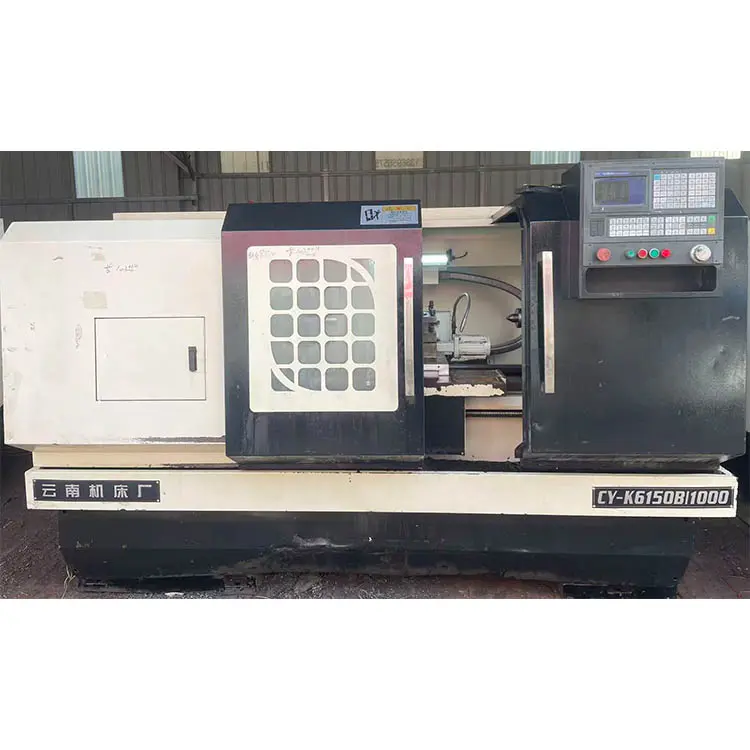
| Model class | Swing over bed | Swing over cross slide | Bore | Power | Weight | Workpiece | Used price guide |
|---|---|---|---|---|---|---|---|
| CW6163C (630 mm) | 630 mm | 350 mm | 105/130 mm | 11 kW | 3.8–4.2 t | ~2000 kg | USD 4,000–9,000 |
| CW6280C (800 mm) | 800 mm | 480 mm | 105 mm | 15 kW | 10–11 t | ~3000 kg | USD 8,000–14,000 |
| CW62125B (1250 mm) | 1250 mm | 850 mm | 130 mm | 22 kW | ~8.5 t | 6000 kg | USD 7,000–20,000 |
| Used slant-bed CNC | 530–900 mm | — | 117–185 mm | 30–45 kW | 6.5–12 t | 2000–4000 kg | USD 25,000–90,000 |
Those are public listing bands we track across Chinese and international marketplaces, and they move with condition, tooling and location. A machine with two steady rests, a full chuck set and a taper attachment is worth more than the same machine bare, because those accessories are expensive and hard to source separately. Treat every number here as a starting point for negotiation, not a valuation.
What Should You Check on the Machine Before You Pay?
Most used lathes are sold on photographs. The photographs never show the bed. That is not an accident.
Check the bed for concavity with a straightedge and feeler gauge at three positions, check bed twist with an indicator over full carriage travel, check spindle runout with a test bar, and cut a real shaft before you pay.
In our yard in Liaocheng I have watched buyers put a tape measure across a bed and call it inspection. The tape tells you the width. It tells you nothing about whether the two ways still point at each other after thirty years of chips and coolant.
Bed Wear Comes First, Always
Lay a precision straightedge along the ways at the headstock end, the middle and the tailstock end. Slide a feeler gauge underneath. A worn lathe shows a dish: the straightedge touches in the middle and daylight appears at both ends. Light wear is normal on a used machine. Visible concavity near the headstock is not, because that is exactly where your heaviest cuts happen.
Why it matters here specifically: bed wear near the headstock drops the saddle, which drops the tool centre below the spindle centreline. On small work you compensate with a shim. On a 600 mm shaft the same drop produces a taper you cannot dial out, and it changes along the length as the saddle travels out of the worn zone.
Bed Twist and Tailstock Alignment
Mount an indicator on the carriage and traverse the full bed. Industrial machines should hold within roughly 0.0005 inch, about 0.013 mm, over full travel. Anything more means the machine is sitting on a bad foundation, was dropped in transit, or has a twisted bed.
Then bring the tailstock centre up to the headstock centre with a test bar. They should meet. If they do not, either the tailstock needs shimming or the bed is worn — and those two problems have very different price tags.
Spindle, Backlash and the Real Test Cut
Spindle radial runout should be within 0.005 mm on a machine of this class. Cross-slide backlash under about one-twelfth of a handwheel revolution is acceptable; a sixth or more means a worn nut.
Then cut something. A test cut on a scrap shaft of at least 400 mm diameter, taken over at least 600 mm of length, tells you more than a full page of indicators. Measure the diameter at both ends. If you see more than 0.02 mm of taper per metre on a machine sold as ready to work, either the setup was wrong or the machine is not ready.
This is the point where the Gulf Industrial Equipment LLC order in Saudi Arabia was decided. Their team would not release payment until they had running video, a taper measurement from a real cut and an SGS inspection report. That is the right instinct. A seller who resists those three requests is telling you something.
| Check | Tool | Pass | Investigate | Walk away |
|---|---|---|---|---|
| Bed concavity | Straightedge + feeler gauge | <0.02 mm at all three positions | 0.02–0.05 mm near headstock | Daylight at both ends with middle contact |
| Bed twist | Indicator on carriage, full travel | <0.013 mm | 0.013–0.03 mm | >0.03 mm |
| Spindle runout | Test bar + indicator | <0.005 mm | 0.005–0.015 mm | >0.025 mm |
| Cross-slide backlash | Dial and handwheel | <1/12 turn | 1/12 to 1/6 turn | >1/6 turn |
| Tailstock alignment | Test bar between centres | Centres meet | Offset under 0.02 mm | Visible offset |
| Test cut taper | Micrometer, 600 mm span | <0.02 mm/m | 0.02–0.05 mm/m | >0.05 mm/m |
| Steady rest condition | Visual + jaw fit | Jaws lap to diameter | Worn jaws, repairable | Missing rests entirely |
That last row is worth money. Steady rests for a 1250 mm lathe are not off-the-shelf items. If the machine arrives without them, you may spend months finding a set, and the machine sits idle in the meantime. Ask for a photographed inventory of every accessory before the container is packed, not after.
If you are still narrowing the field, our used lathe machine listings show current stock with bed condition notes, and the used CNC lathe section covers the slant-bed options. For heavy shaft work in particular, it is worth reading our lathe inspection checklist before you book a flight.
Conclusion
Large-diameter shaft turning is a support problem before it is a power problem. Buy the machine whose bed, bore and steady rests match your heaviest part.